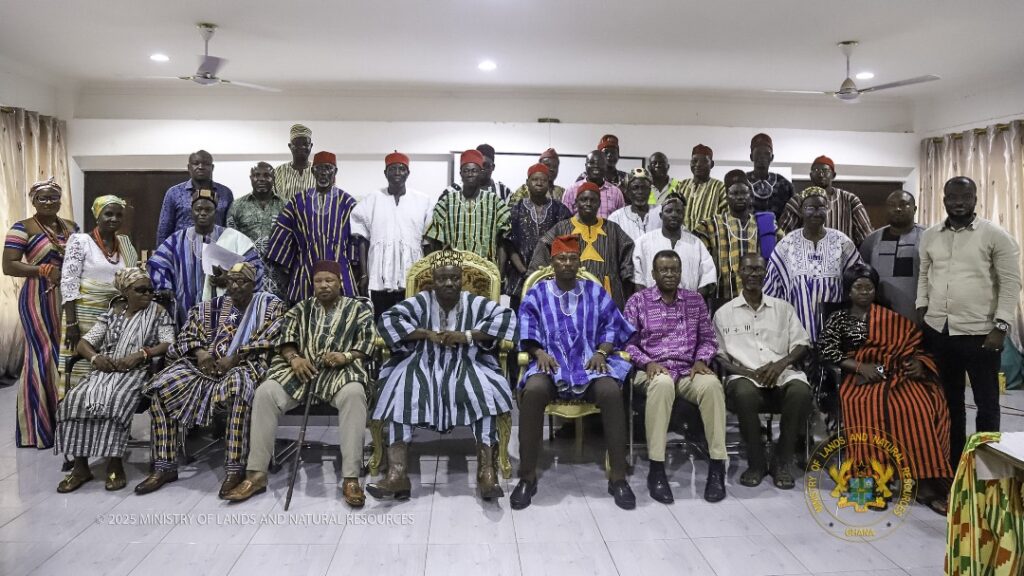
The Advisor to the Minister for Lands and Natural Resources, Prof. Jerry Kumah, has emphasized the need to engage with the Upper East Regional House of Chiefs with the deliberate intention of harnessing their collective expertise and insights, which will subsequently inform the formulation of a comprehensive report to be presented to Parliament.
This report, he said, will serve as a foundational document for stakeholder deliberations aimed at refining the legislative framework, thereby ensuring that the resultant policy is both efficacious and forward-looking.
Prof. Kumah reiterated that the regulatory framework governing the mining sector in Ghana is vested in the Ministry of Lands and Natural Resources, the Minerals Commission, and the Health Agency, all mandated to ensure compliance with the country’s Constitution.
The Minerals and Mining Law, Act 2006 (Act 703), and its amendments, which have been in effect for nearly two decades, require a comprehensive review to align with contemporary global trends, national policies, and evolving best practices in the mining sector. Similarly, the Minerals and Mining Policy of 2014, which is now over 11 years old, necessitates a review, given that it was initially intended to be reviewed every five years.

He underscored the paramount importance of active participation from all attendees, noting that their contributions are pivotal in shaping a policy that is comprehensive, well-informed, and tailored to meet the diverse needs of all stakeholders.
“In this regard, I would like to express my profound gratitude to each and every one of you for your presence and engagement in this critical stakeholder meeting and to acknowledge the invaluable role that you will play in shaping the future of our mining sector,” he said.
Mr. Benjamin Aryee, former Chief Executive Officer of the Minerals Commission and Advisor to the Minister, presented a comprehensive review of the 2014 Mining Policy, highlighting salient new provisions. These include the introduction of a Green/Critical Minerals Policy, which underscores the imperative of sustainable mining practices, as well as emerging global trends such as climate change and the increasing importance of Environmental, Social, and Governance (ESG) standards.
Additionally, the review touches on government policies, including the innovative concept of cooperative mining and the recategorization of mining with the establishment of a medium-scale category.
He emphasized that the confluence of emerging global trends, such as climate change and the growing significance of transition minerals, coupled with the challenges encountered during the implementation of the policy over the past decade, necessitates a paradigm shift in Ghana’s approach to mining.
The Minerals and Mining Policy is guided by several notable principles, including fostering local content, promoting transparency and accountability, and ensuring equitable development that respects the rights of host communities.
Effective consultation with mining communities is a crucial aspect of the mineral licensing process, enabling the government to achieve objectives such as striking a socially acceptable balance between mining and environmental protection, ensuring occupational health and safety, eliminating child labour, and reducing the environmental impacts of mining through measures like the adoption of mercury-free machines in artisanal and small-scale mining (ASM), in line with the Minamata Convention.
Other objectives include improving public health in mining communities, ensuring fair revenue sharing, promoting safe and affordable mining technology, and supporting sustainable value chain development across the sector.
Josef Iroko, Legal Manager at the Ministry, highlighted the proposed amendments to the Minerals and Mining Act, 2006 (Act 703), emphasizing the need to incorporate a gender-sensitive approach that mainstreams gender considerations into the mining industry.

He also provided an overview of the key proposed amendments, including the introduction of a Community Development Agreement (CDA) requiring mining companies to allocate 1% of their revenue to local development; the creation of a medium-scale mining category; a review of existing contracts to ensure fairness and national alignment; and new requirements for obtaining environmental and operating permits prior to the commencement of mining operations.
Other changes include limiting prospecting licenses to nine years and mining leases to fifteen years; decentralizing the Minerals Commission’s services to improve accessibility for small-scale miners; promoting local content development; and reforming fiscal policies to enhance transparency and financial governance in the sector.
These amendments aim to create a more inclusive, transparent, and sustainable mining industry that contributes meaningfully to Ghana’s national development. The review process involves broad consultations with traditional leaders, academia, civil society organizations, and small-scale miners.
The President of the Upper East Regional House of Chiefs, Pe Ditundini Adiali Ayagitam III, expressed his full support for the proposed legislative amendments, underscoring the government’s commitment to inclusive policy-making and the critical role of traditional leadership in shaping Ghana’s mining future.
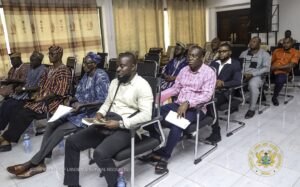
“We take pride in being integral to this discourse and are enthusiastic about contributing to the future trajectory of responsible mining in our nation, thereby ensuring a sustainable and equitable exploitation of our mineral resources,” he stated.
He noted that the meeting presented an important opportunity for traditional custodians of the land to offer insights on the proposed changes to the Minerals and Mining Act, 2006 (Act 703), and the Mining Policy. He commended the government for adopting a consultative approach that acknowledges the vital role of traditional authorities in land management and community development.
One perennial concern raised by traditional leaders, he added, is the lack of adequate consultation during the issuance of mining leases, particularly to large-scale companies. Often, they are only informed after key decisions have already been made—a practice that undermines their authority and erodes community trust.
This, he emphasized, underscores the urgent need for a more inclusive and participatory decision-making process going forward.