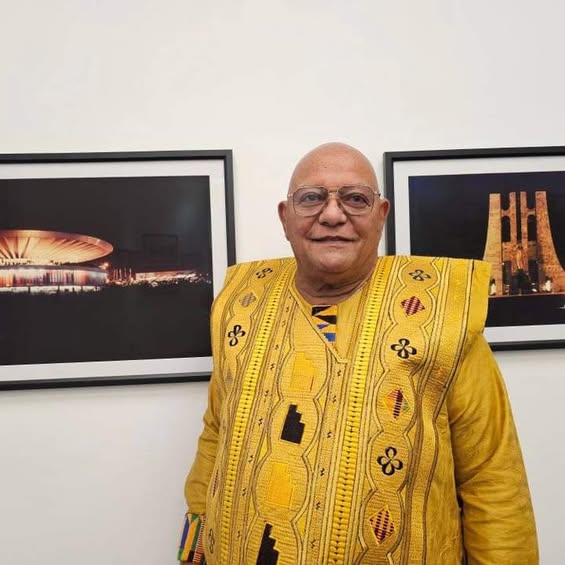
Tributes are pouring in across Ghana and beyond following the passing of Gerald Annan-Forson, the renowned Ghanaian photographer whose groundbreaking work defined visual storytelling in Accra and across the African continent for decades.
It is not yet clear what led to his demise.
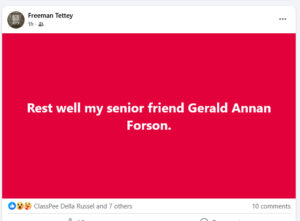
His death was however confirmed by Police Commander for Parliament House Freeman Tettey on Thursday 7 August.
“Rest well my senior friend Gerald Annan Forson,” wrote Police Commander Freeman Tetteh in a heartfelt Facebook tribute, echoing the sentiments of many mourning the loss of a creative pioneer, mentor, and cultural documentarian.
Born in London in 1947 to a Ghanaian father and an Irish mother, Annan-Forson returned to Ghana in the 1970s with a camera, a vision, and a deep desire to challenge the negative narratives dominating coverage of the country. He soon became one of Ghana’s most daring visual voices—capturing not only the everyday but the political, the poetic, and the profound.
In 1976, he began work as a freelance photographer, and by 1977, had secured a press card from the Ministry of Information. This gave him unprecedented access to document the country at a time when Ghana’s political landscape was turbulent and press freedom was limited. He photographed intimate moments of ordinary Ghanaians, major public events, and high-ranking political figures—including Jerry John Rawlings and Hilla Limann—offering unique visual accounts of Ghana’s complex history.
His work went beyond conventional photojournalism. “His brilliance as a photographer is to find the subtle, intimate moments in the midst of daily life,” said Jesse Weaver Shipley, a professor at Dartmouth College and curator of Annan-Forson’s first U.S. retrospective currently on display at the Howard University Museum in Washington, D.C.
Annan-Forson’s relationship with Ghana’s political class ran deep. A schoolmate of Rawlings at Achimota College, he was granted unusual access to the former president’s private and public life. His 1979 photo of Rawlings handing over power to President Limann at Black Star Square is now one of Ghana’s most iconic images.
Yet, his photography was not without peril. During General Acheampong’s regime, he was arrested and interrogated—his camera lens mistaken for a bazooka. Suspected of being a foreign agent for his fluency in Ghanaian languages, he continued his work with courage and integrity.
His contribution to the arts and to Ghanaian visual culture was immense. In 1987, he co-founded the Ghana Union of Professional Photographers to mentor and support younger artists. His images, rich with social commentary and cultural insight, have been exhibited globally—including in the Sharjah Art Foundation and now in the U.S., where they are finally receiving long-overdue scholarly and artistic recognition.
One of the most striking exhibitions of his legacy, titled Routes of Rebellion, includes a short documentary by Shipley called Burnt Images, which delves into Annan-Forson’s life and the role of photography in resisting racial and political oppression.
Despite the international accolades, Annan-Forson remained humble. “I never thought about getting credit or, for that matter, getting cash,” he once said. “I just wanted to show the beauty, struggle, and truth of Ghana.”
His appointment by the British High Commission to photograph Queen Elizabeth II during her 1999 visit to Ghana was a particularly proud moment. “They said, ‘We have been watching you. We’ve selected you from within Ghana,’” he recalled in a recent interview with ARTnews. For a man who once stood outside Buckingham Palace hoping to one day capture the royals, it was a full-circle moment.
Gerald Annan-Forson may have laid down his camera, but his images—full of soul, struggle, and the spirit of Ghana—will continue to speak across generations.