Former Chief Executive of the Ghana Chamber of Mines, Rev. Dr Joyce Aryee, has issued a powerful call for Ghana to radically rethink its mining sector, warning that the country risks destroying its own future if leaders fail to adopt a clear, courageous, and long-term vision.
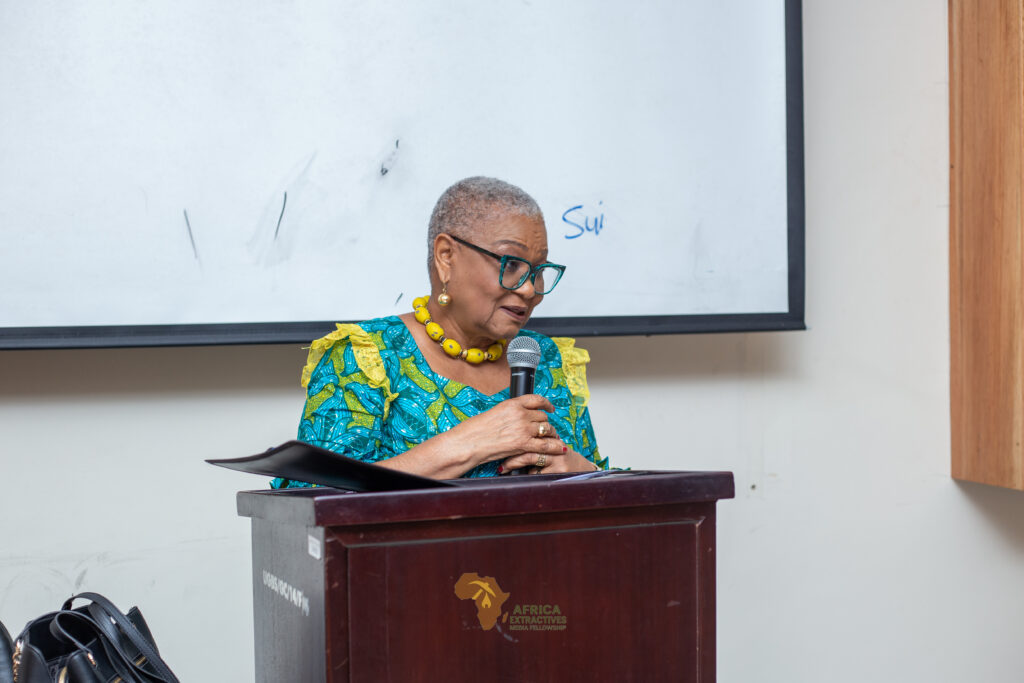
Speaking at the second session of the Africa Extractive Media Fellowship in Accra on Wednesday, 26 November, she said the nation has been “pillaging the land” and sacrificing water bodies, forests, and communities due to poor planning and the absence of generational leadership.
Dr Aryee argued that every mining policy must begin with a fundamental national question: Why do we want to mine?
According to her, if Ghana’s approach to mining is driven only by revenue, then “we have already lost the plot.” She stressed that mining carries a dual mandate—economic contribution and environmental stewardship—and that the country must balance the two to secure long-term prosperity.
She criticised Ghana’s tendency to allocate large tracts of land to investors without considering future technological advances or the long-term value of the land itself. “No one comes to invest because he is a philanthropist,” she cautioned. “The country and the company must benefit mutually.”

On illegal mining, she said the problem persists because criminal networks enjoy protection from political and security actors. She lamented the destruction of rivers and forests, noting that snails and mushrooms have become scarce because the ecosystems that support them have collapsed. “When we think of mining, we must think of agriculture,” she said, calling for stronger collaboration between sectors.
Dr Aryee stressed that compliance with mining laws alone cannot deliver sustainable development. What Ghana needs, she argued, is national courage backed by a clear vision of where the country wants to be in the next 20, 30, or 40 years. She described Ghana’s planning system as “very deficient,” with no long-term blueprint guiding how the mining sector should evolve.
She extended this criticism to the education system, noting that thousands of students graduate in fields like law with little alignment to Ghana’s development needs. Without strategic planning, she warned, “frustration will be next door.”
Dr Aryee highlighted the gender gaps entrenched in Ghana’s extractive sector. Women account for only a small share of the mining workforce and often serve as labourers earning less than men. She cited the example of Gold Fields, where only two of 20 board members are women.
She called for SMART gender provisions in all extractive frameworks and urged the sector to adopt quotas that promote greater participation of women at all levels.
Addressing the relationship between mining companies and host communities, Dr Aryee said corporate social responsibility should be embedded directly into corporate strategy—not treated as an afterthought. She urged companies to go “beyond what the law requires” and create shared value that benefits both communities and mining firms.
Compensation alone, she said, is not enough. True CSR must consider long-term livelihoods, environmental stewardship, and equitable development.
Turning her attention to journalists, she charged the media to use its platform to shape development-focused thinking, not political propaganda. The value of journalism, she said, lies in its ability to influence policy, foster integrity, and rebuild national cohesion in an increasingly polarised environment.
“If your work does not influence policy, of what value is it?” she asked. She urged journalists to champion environmental stewardship, highlight the impacts of mining on communities, and promote sustainable practices such as tree planting.