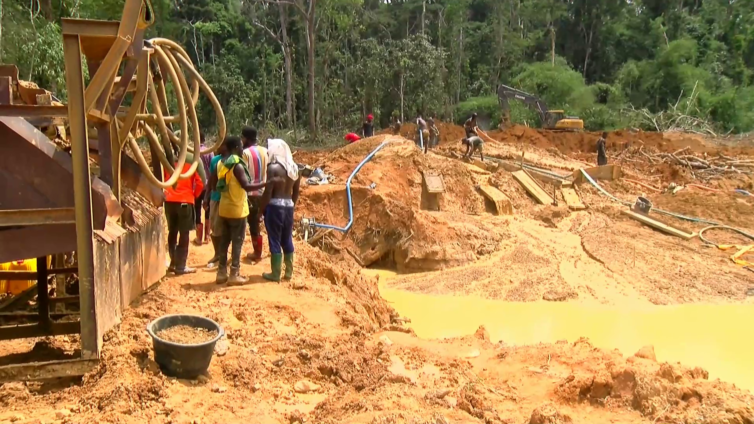
illegal miners
Convener of the OneGhana Movement and Trustee of the Ghana Coalition Against Galamsey, Senyo Hosi, has called for a fundamental shift in Ghana’s approach to illegal mining, warning that attempts to completely eradicate galamsey are unrealistic.
Speaking in an interview on JoyNews’ Newsfile on Saturday, March 21, Mr. Hosi argued that illegal mining has become deeply entrenched in Ghana’s socio-economic fabric and must instead be managed through regulation, technology, and pragmatic policy reforms.
“We have to get the reality that galamsey is not going anywhere. That is what I see. We have to find a way to correct the externalities around that,” he stated.
According to him, the persistence of galamsey is driven by powerful economic and political forces, including its role in providing livelihoods for thousands of Ghanaians and its links to political financing.
Mr. Hosi noted that government itself faces a difficult balancing act, as any significant drop in gold production could have wider macroeconomic consequences.
“Gold production drops, and then you’re dealing with macroeconomic problems. Politicians are also being funded by actors within this space,” he added.
Shift from Eradication to Control
Rather than continued crackdowns, Mr. Hosi proposed a strategic pivot towards formalising and regulating the sector. He stressed that current enforcement-heavy approaches are unlikely to succeed because they fail to address the underlying economic incentives.
“There’s no going back. The question is: how do we rationalise what is happening?” he questioned.
Low Recovery, High Losses
Highlighting inefficiencies within the sector, Mr. Hosi revealed that many small-scale and illegal mining operations achieve only about 30 percent gold recovery, leading to substantial losses in potential revenue.
In contrast, large-scale mining companies typically record recovery rates between 85 and 95 percent.
Technology as a Solution
Mr. Hosi identified technology as a critical tool for transforming the sector. He suggested that adopting modern mining techniques could significantly improve recovery rates, reduce environmental damage, and increase government revenue.
“Can we use technology to correct the losses and move closer to large-scale recovery levels?” he asked.
Formalisation Over Criminalisation
He further advocated the full regularisation of artisanal and small-scale mining (ASM), arguing that bringing operators into the formal economy would enable better oversight and compliance.
Such an approach, he explained, would allow government to maintain control of the sector while safeguarding livelihoods.
“Let it be fully compliant, supported with technology, so government can guide the sector while people do it properly,” he said.
Environmental Concerns Remain
While acknowledging that interventions such as water purification technologies could mitigate some damage, Mr. Hosi cautioned that these measures are not sufficient on their own.
He emphasised the need for stricter regulation of harmful practices, including the use of toxic chemicals such as cyanide, to protect the environment.
Call for Policy Realism
Mr. Hosi concluded by urging policymakers to abandon idealistic approaches in favour of realistic, balanced strategies that align with conditions on the ground.
“Technology and policy must be brought together to correct this. Doing nothing is not going to help anybody,” he cautioned.