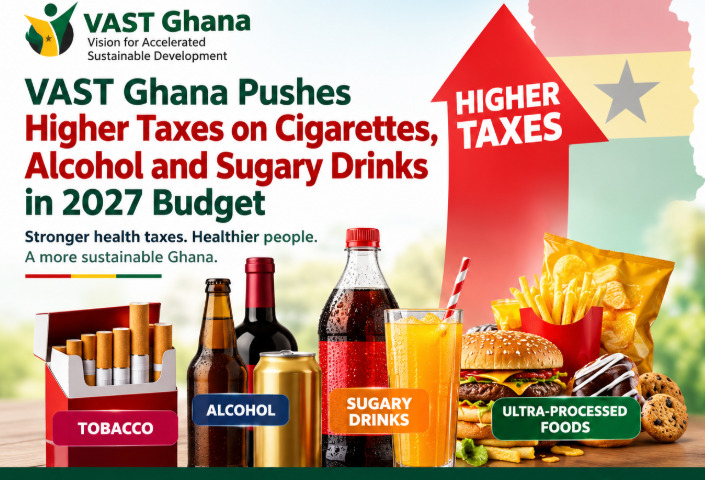
Vision for Accelerated Sustainable Development Ghana (VAST Ghana) is calling on the government to raise the specific excise tax on cigarettes from GHC0.28 to GHC1 per stick and introduce higher taxes on alcohol, sugary drinks and ultra-processed foods as part of reforms to the 2027–2030 national budget.
The organisation says Ghana must adopt stronger health taxes to reduce the growing burden of non-communicable diseases (NCDs), discourage the consumption of harmful products and mobilise additional domestic revenue to finance healthcare.
In a statement issued on Friday (October 30), VAST Ghana urged the Ministry of Finance to make comprehensive excise tax reforms a priority in the next budget framework, arguing that existing tax measures have not sufficiently addressed the health and economic costs associated with tobacco, alcohol and sugar-sweetened beverages.
The organisation cited tobacco consumption as a major economic and public health concern, estimating that it claims more than 6,700 lives annually in Ghana and causes economic losses of about GHC668 million.
It argued that the cost of tobacco-related illnesses and productivity losses outweighs the benefits of maintaining relatively low tobacco prices.
VAST Ghana is also proposing an increase in the ad valorem tax on tobacco products from 50% to 100%, alongside the adjustment of the specific excise tax, to bring total tobacco taxes to 75% of the retail price.
On alcohol, the organisation wants the government to extend the hybrid excise tax structure to all categories, including beer, wine, cider, spirits and ready-to-drink products. It also recommends that taxation be linked to alcohol content, measured by alcohol by volume (ABV), and complemented by a minimum pricing policy.
For sugar-sweetened beverages, VAST Ghana is proposing a hybrid excise system that combines the existing 20% ad valorem rate with a specific tax based on free-sugar content.
It is also calling for the reintroduction of the 20% excise tax on locally produced fruit juices, arguing that some fruit juices contain substantial amounts of free or concentrated sugars and should not automatically be treated as healthier alternatives.
Beyond tobacco, alcohol and sugary drinks, the organisation wants excise taxes introduced on ultra-processed foods containing excessive levels of sugar, sodium and saturated fats.
VAST Ghana further called for the removal of e-cigarettes and e-liquids from the excise tax schedule, arguing that their inclusion creates inconsistencies with Ghana’s public health laws, which prohibit them.
It also wants the government to introduce annual automatic adjustments to specific excise taxes to prevent inflation and income growth from making harmful products more affordable.
The organisation is proposing that a defined proportion of revenue generated from health taxes be allocated to non-communicable disease prevention, health promotion and priority healthcare interventions, including the Ghana Medical Trust Fund and the proposed Free Primary Healthcare policy.
VAST Ghana said the proposed reforms are consistent with the World Health Organisation’s 3 by 35 Initiative, which calls on countries to increase the real prices of tobacco, alcohol and sugary drinks by at least 50% by 2035 through taxation.
It said stronger health taxes could help Ghana reduce premature deaths from NCDs while strengthening domestic financing for essential health services.
The organisation therefore urged the Ministry of Finance to incorporate the proposals into the 2027–2030 Budget Statement and Economic Policy.