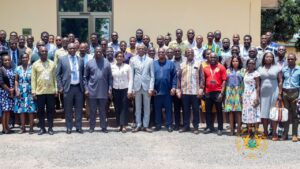
Emmanuel Armah-Kofi Buah(middle)
The Minister for Lands and Natural Resources, Emmanuel Armah-Kofi Buah, has called for a fundamental shift in the operational model of the Ghana Geological Survey Authority (GGSA), urging the institution to transition into a commercially viable body that no longer relies on government subvention.
The Minister made this call during his first official visit to the GGSA on Thursday, April 10, 2025. Clearly taken aback by the Authority’s continued dependence on public funding,
Armah-Kofi Buah pledged to work closely with the leadership and staff to reposition the GGSA as a self-sustaining entity that contributes meaningfully to Ghana’s economy.
“There is no reason why an organization like yours should constantly struggle with funding,” he said. “We must take steps to improve your financial standing because the services you provide must translate into revenue. I don’t see why employees of other institutions should be paid better than you. Your work is critical, and I am committed to working with you to drive this change.”
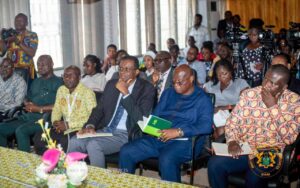
The Minister emphasized that the GGSA is one of the most vital institutions under his Ministry, with the potential to become a significant revenue earner for the nation.
He reiterated the need for all agencies under his supervision to align with the government’s broader reset agenda, led by President John Dramani Mahama, and called on the GGSA’s staff to commit to this new direction. “Everyone here must work toward achieving the government’s reset agenda for the GGSA. If we all fulfill our responsibilities, we will move in the right direction together,” he said.
In response, the Director-General of the GGSA, Isaac Kuuwan Mwinbelle, welcomed the Minister’s visit as a strong indication of his commitment to reforming the institution.
He took the opportunity to outline a number of ongoing projects that reflect the Authority’s strategic relevance, including investigations into limestone deposits in the North-East Region and clay in the Eastern and Central Regions.
He also spoke about the preparation and update of district mineral occurrence maps in the Ashanti Region, as well as nationwide earthquake monitoring and geohazards assessments, supported by public sensitization on seismic risks.
Mwinbelle highlighted that the GGSA’s agenda for 2025 is focused on enhancing Ghana’s geological resource management. Key among their goals is the development of a 10-year strategic plan to provide a clear roadmap for sustainable operations in line with national priorities.
Additionally, the Authority is working to operationalize Act 928 (2016), which will strengthen its regulatory role and boost its institutional effectiveness.
Upgrading the national seismic network to adopt modern, real-time data transmission systems is also a priority, along with the regular publication of technical geological bulletins to support knowledge dissemination and decision-making across sectors.