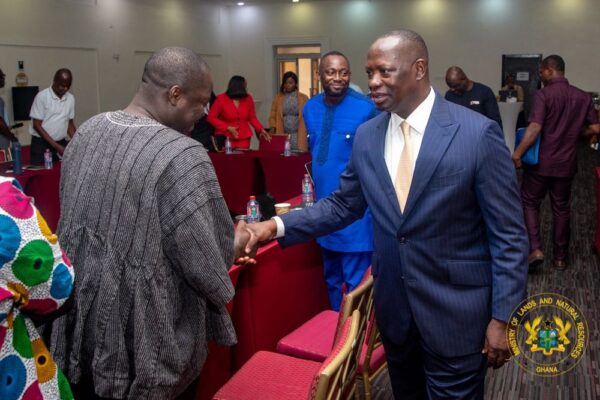
Emmanuel Armah-Kofi Buah (Right)
The Minister for Lands and Natural Resources, Emmanuel Armah-Kofi Buah, has opened Ghana’s lithium agreement to intense stakeholder scrutiny, holding high-level talks with civil society organisations (CSOs) following the withdrawal of the deal from Parliament.
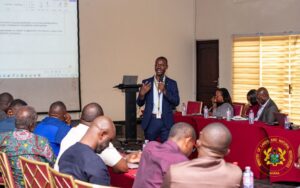
The meeting, held on Monday, December 13, 2025, forms part of government’s reset of Ghana’s lithium strategy after widespread concerns over the original agreement.
The recalled deal involved Barari DV Ghana Limited, a local subsidiary of Atlantic Lithium, and covered lithium exploration at Ewoyaa in the Central Region.
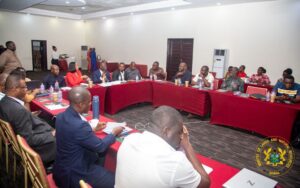
Addressing the CSOs, the Lands Minister said government is determined to craft a lithium agreement that delivers real value to the people of Ewoyaa and the country, stressing that the era of poorly negotiated mineral agreements must give way to transparency, fairness and national benefit.
He invited frank and constructive feedback to strengthen the framework of a new agreement, assuring participants that all credible concerns would be reflected in the revised documentation.
CSO representatives raised far-reaching issues, including Ghana’s royalty and equity stakes, environmental protection, community development, gender inclusion, health and safety, and long-term sustainability of lithium mining. The discussions also touched on governance safeguards to ensure that the strategic mineral contributes meaningfully to Ghana’s industrialisation and energy transition agenda.

The Minister acknowledged the concerns and pledged that government would incorporate the inputs into a revised deal that aligns with Ghana’s development priorities and international best practices.
Natural resource governance expert, Dr Steve Manteaw, commended the Minister for opening the process to wider public engagement, describing the move as critical to safeguarding the country’s mineral wealth.
Policy analyst at the Centre for Environmental Management and Sustainable Energy (CEMSE), Benjamin Nsiah, urged government to institutionalise stakeholder consultations in the management of strategic minerals such as lithium.
Further contributions from Patrick Stephenson of the Natural Resource Governance Institute (NRGI), Benjamin Boakye of the African Centre for Energy Policy (ACEP), Samuel Bekoe of the Centre for Extractives and Development Africa (CEDA), and other participants deepened the debate on maximising national value from Ghana’s lithium discovery.
Also present at the meeting, Atlantic Lithium’s Country Manager, Ahmed Salim, welcomed the critiques and called for continued collaboration in developing a new agreement that commands public confidence.

Concluding the engagement, Mr Buah assured stakeholders that consultations would continue, stressing that government is committed to ensuring Ghana’s lithium resources become a national asset rather than a missed opportunity.
He disclosed that additional stakeholder engagements are planned as part of efforts to secure a deal that delivers lasting benefits for present and future generations.