Ing Ken Ashigbey
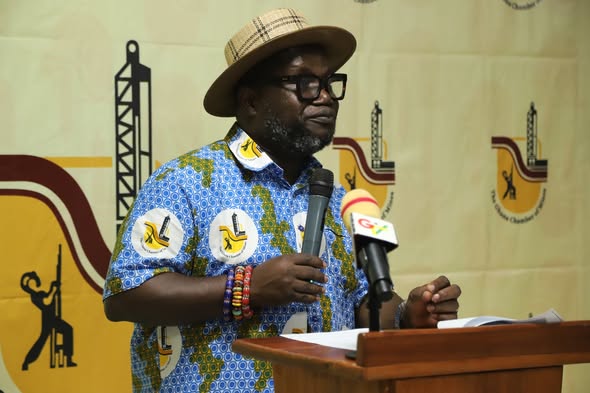
Ken Ashigbey, Chief Executive Officer of the Ghana Chamber of Mines, has defended Gold Fields Ghana against criticisms surrounding the company’s mining lease, investments and contribution to Ghana’s economy.
His comments follow a Facebook post by private legal practitioner Kofi Bentil, who questioned the financial terms under which Gold Fields acquired its mining rights and challenged claims that the company had made significant investments in developing the Tarkwa mine.
Bentil also questioned the company’s reported cumulative revenue of US$30 billion over the years and raised concerns about who would bear the responsibility for reclaiming land after decades of mining operations.
Responding to the concerns, Ashigbey said the debate must be informed by accurate figures and a proper understanding of Ghana’s mining regulatory framework, warning against the selective presentation of information that could create misleading impressions.
On the reported US$30,000 consideration for the mining lease, Ashigbey explained that Gold Fields’ agreement was consistent with standard mining lease arrangements in Ghana at the time.
He argued that the figure should not be interpreted as the company’s total financial commitment to securing and maintaining its mining rights.
According to him, mining companies are subject to several statutory payments, including application and processing fees, annual mineral rights fees, ground rent and other applicable charges, which may not be reflected in the consideration clause of a lease agreement.
Ashigbey further disclosed that Gold Fields paid approximately US$3 million in 1992/93 to access geological and technical information relating to the then underground Tarkwa Mine, which was reportedly loss-making and producing between 12,000 and 24,000 ounces of gold annually.
He clarified, however, that the payment was not consideration for the mining lease but formed part of the broader financial commitments and risks associated with assessing the mining opportunity.
The company also made a separate payment for the assets of the State Gold Mining Corporation’s Tarkwa Mine, based on an independent valuation.
On investments made to transform the operation, Ashigbey acknowledged that Gold Fields’ capital expenditure was primarily driven by commercial interests but maintained that the investments had also generated significant economic and social benefits for Ghana.
He said the company transformed what was initially an underground mining operation into a large-scale surface mining business, involving substantial capital investment and the relocation of affected surface rights holders to newly developed communities, including New Atuabo in Tarkwa.
He identified corporate taxes, royalties, the State’s 10 per cent free-carried interest, employment, local procurement and community investments as some of the benefits accruing to Ghana and other stakeholders.
Ashigbey stressed that development expenditure should not be confused with payment for mining rights. However, he argued that assessing the value generated by the mine required consideration of the capital invested, risks assumed and economic benefits distributed.
Addressing claims that Gold Fields had generated approximately US$30 billion in revenue over the past three decades, Ashigbey disputed the figure, describing it as doubtful and questioning its authenticity.
He also emphasised the distinction between gross revenue and profit, explaining that revenue generated from mining operations does not represent money retained by the mining company.
According to him, mining operations involve significant capital and operational costs, including wages, energy, equipment, maintenance, financing and environmental management, which must be accounted for before profits can be determined.
He therefore called for a comprehensive assessment of Gold Fields’ actual profits, capital investments, taxes, royalties, dividends and other economic contributions rather than comparisons based on cumulative revenue and an isolated lease consideration figure.
Ashigbey further claimed that approximately 74 per cent of every dollar of value generated by Gold Fields remains in Ghana through corporate taxes, royalties, government dividends, employee compensation, local procurement and community investments.
On concerns about environmental rehabilitation after decades of mining, Ashigbey maintained that responsibility for reclaiming disturbed land rests with the mining company, subject to regulatory oversight.
He explained that mining companies are required to undertake progressive rehabilitation and make financial provisions for eventual mine closure and environmental restoration.
Providing details of Gold Fields’ arrangements, he disclosed that the company had maintained a Reclamation Security Agreement (RSA) with the Government through the Environmental Protection Authority since 2003.
Under the agreement, the mine’s closure liability is calculated annually based on disturbed areas that cannot immediately be reclaimed because of ongoing operational requirements.
The financial obligations are secured through cash bonds and bank guarantees held with a bank in Ghana, with the security reviewed annually to reflect changes in estimated closure liabilities.
Ashigbey disclosed that Gold Fields’ closure liability stood at US$82.47 million in 2023 and increased to US$92.74 million in 2024.
As of December 31, 2025, the estimated liability had risen to US$107.19 million.
However, the company’s existing closure security bond with Absa Bank Ghana Limited stood at US$83.9 million, comprising US$36.78 million in bank guarantees and US$47.12 million in cash.
He said the company was adjusting the bond to align it with the December 2025 closure liability and currently sets aside US$500,000 monthly towards its eventual closure obligations.
Ashigbey also revealed that Gold Fields had invested approximately US$46 million in progressive rehabilitation since 2016, with annual expenditure averaging US$4.2 million.
He rejected the description of mined-out areas as simply a ‘hole’, explaining that they were open pits, a common feature of surface mining operations in Ghana and other mining jurisdictions.
Ashigbey also used his response to highlight what he described as the importance of security of tenure and predictability in Ghana’s mining investment environment.
He argued that Ghana must protect its mineral resources and secure greater benefits for its citizens while maintaining a regulatory environment capable of attracting responsible long-term investment.
According to him, mining is a capital-intensive and high-risk business that requires substantial financial commitments over extended periods.
He maintained that investors must have confidence that the country’s laws and contractual obligations will be applied fairly and consistently.
Ashigbey said the Ghana Chamber of Mines’ position was that Gold Fields, having materially complied with the terms of its existing lease, should have its mining lease renewed in accordance with the law.
He, however, stressed that renewal should provide an opportunity to negotiate appropriate terms that reflect current economic, environmental and social realities.
Such arrangements, he said, should secure greater and more sustainable benefits for Ghana, particularly host communities, while providing the company with the certainty needed to continue investing, creating jobs and generating economic value.
Ashigbey welcomed public scrutiny of mining agreements and the returns Ghana receives from its mineral resources but urged participants to ground the debate in evidence, fairness and sound economic analysis.
He said the national conversation should extend beyond the amount of revenue collected by the State to how effectively mineral revenues are managed and converted into sustainable development, improved livelihoods and lasting economic opportunities.
He also highlighted the importance of intergenerational equity, arguing that the country’s finite mineral resources must be transformed into enduring national assets and productive investments for future generations.
Ashigbey invited Bentil and other stakeholders to engage in a broader discussion on how Ghana could maximise the benefits of its mineral wealth.
He maintained that protecting Ghana’s interests and respecting investors’ rights were not mutually exclusive, insisting that both were necessary to build a credible and competitive mining industry.