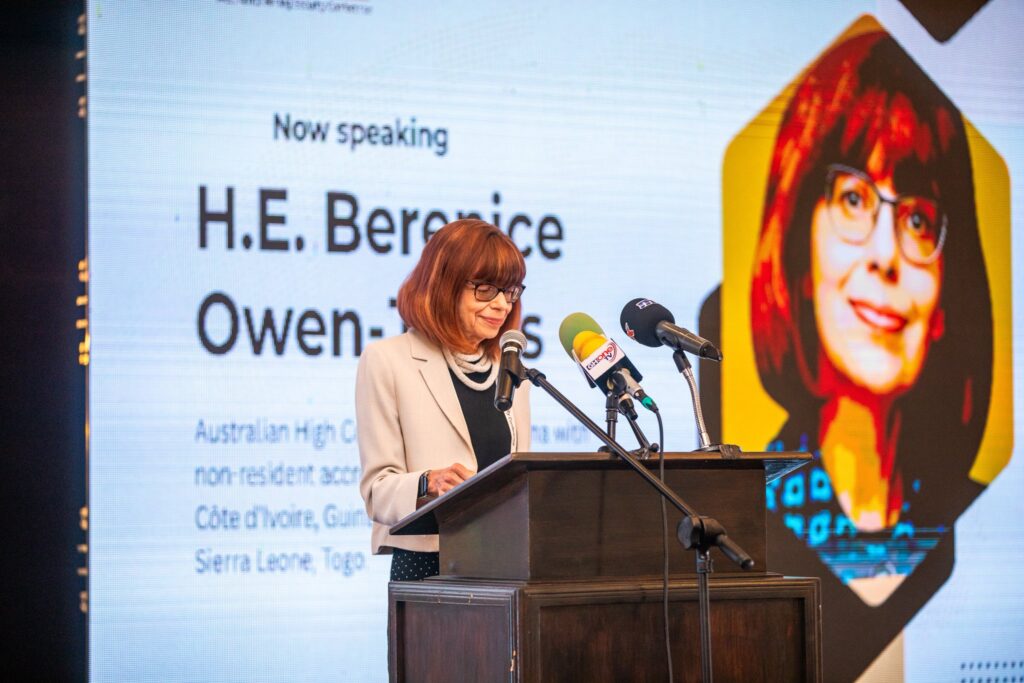
Berenice Owen-Jones,
Australia has renewed its call for stronger regional collaboration to tackle the growing security threats facing West Africa’s mining industry, as terrorism, political instability, and new technological risks increasingly challenge the region’s stability.
Opening the fifth West Africa Mining Security Conference (WAMS) in Accra on Tuesday, Berenice Owen-Jones, High Commissioner of Australia to Ghana, said the shifting security dynamics across the sub-region require greater cooperation among governments, communities, and industry players.
“The growth of terrorism in the Sahel, violent extremism, political instability, complex geopolitics and emerging threats present significant challenges for the mining sector,” she said.
“These are not challenges for the sector to confront alone. They require collaboration between states, communities, security providers and industry.”
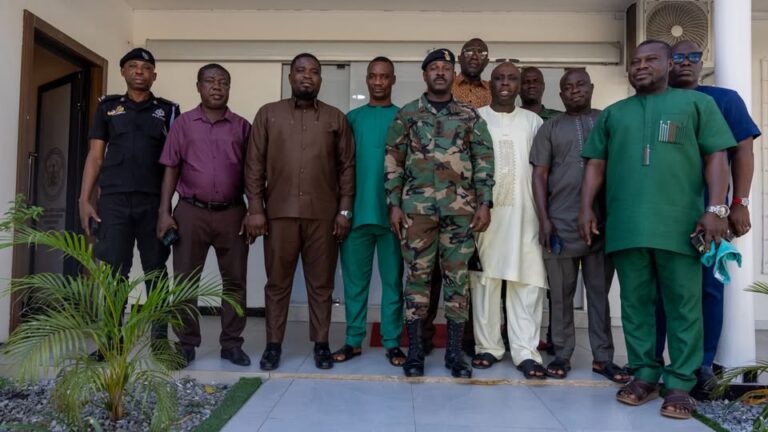
The two-day conference, organised by the Australian High Commission in Ghana in partnership with the Australia-Africa Minerals and Energy Group (AAMEG) and MS Risk Limited, brings together policymakers, security experts, academics, and representatives of the mining industry to assess the evolving security environment and identify practical responses.
Owen-Jones estimated Australia’s commercial engagement in West Africa to be between US$20 billion and US$30 billion, largely concentrated in mining. She noted that Australian companies have been investing in the region for decades, contributing to job creation, skills development, and community growth.
“For these benefits to be realised, mining operations must be conducted in an environment where the impact of security and political risk is understood and mitigated,” she added. “Securing mining operations is not simply about protecting assets — it’s about safeguarding livelihoods, stability, and development in the region.”
Australia’s Ambassador for Counter-Terrorism, Ms. Gemma Huggins, underscored the importance of Ghana and West Africa to Australia’s global counter-terrorism efforts.

“I am here because I do want to emphasise how important this partnership with Ghana is to Australia, and how important countering terrorism on a global level is for Australia,” she said.
Huggins noted that despite geographical distance, Australia and Africa are deeply connected through people-to-people ties, shared security interests, and multilateral cooperation within the Commonwealth and the United Nations.
She said terrorism and violent extremism remain the region’s greatest security challenges, impeding sustainable development and undermining growth.
“Australia remains deeply concerned by the destabilising impact terrorism has on regional security and development. It impedes sustainable development, erodes human rights, undermines economic growth and food security, and exacerbates displacement,” she cautioned.
She also drew attention to the link between illicit mining and terrorism financing, and to the growing use of new technologies by extremist groups.
“In the central Sahel, the rapid increase in drone usage by extremist groups poses a serious challenge to mining companies moving personnel and equipment across vast spaces,” she explained. “We are also seeing increased use of AI and social media to translate and spread messaging and propaganda.”
According to Huggins, 2024 marked the fourth consecutive year that the Sahel remained the most lethal theatre of jihad in Africa, with over 10,500 fatalities recorded.
Huggins reaffirmed Australia’s support for African-led and African-owned solutions to counter-terrorism and extremism. She highlighted development initiatives such as the Africa–Australia Partnership for Climate Responsive Agriculture, which aims to build resilience against climate impacts that often contribute to radicalisation.
She also cited Australia’s collaboration with Ghanaian organisations such as WACCE and FoZTA, and regional partnerships with UNDP and WFP, focused on community sensitisation and livelihood support.
“Australia both respects and endorses the principle of African-led and African-owned solutions,” she said. “Our investments in counter-terrorism training academies in Côte d’Ivoire and Morocco reflect our commitment to facilitating knowledge exchange among African security practitioners.”
She praised the WAMS conference as a vital forum for shared learning and coordination.“This conference is very much an example of our efforts to share information, expertise, and coordinate. We all have a shared interest in the security of West Africa,” Huggins concluded.