Emmanuel Armah-Kofi Buah
Ghana has generated an additional GH¢4 billion in mining royalty revenue following the introduction of a sliding-scale royalty regime, the Minister for Lands and Natural Resources, Emmanuel Armah-Kofi Buah, has said.
He said the revised system, which links royalty rates to prevailing gold prices, was introduced to ensure the country earns more from its mineral resources when prices rise, while reducing the rates when prices fall.
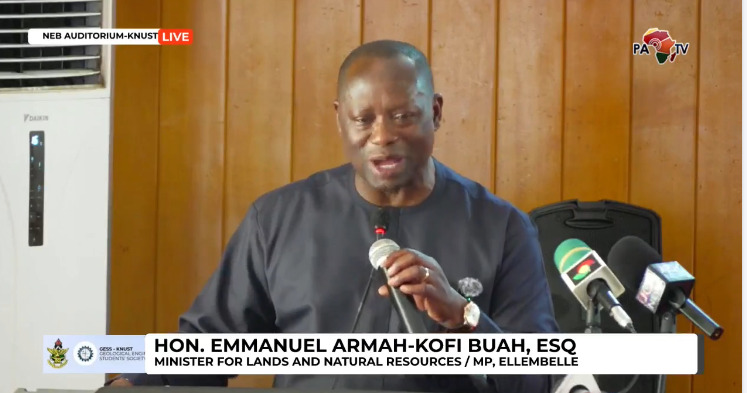
Speaking at the Kwame Nkrumah University of Science and Technology (KNUST) Extractive Summit on the theme, “From Rocks to Resources, to Result: Leading Ghana’s Extractive Future,” Mr Armah-Kofi Buah said the Minerals Income Investment Fund (MIIF) reported GH¢7.82 billion in royalty receipts between January and September 2026.
He attributed the increase in revenue to the sliding-scale regime, which replaced the flat royalty system that had been in place for more than three decades.
Listen to Emmanuel Armah-Kofi Buah in the attached audio:
Under the previous arrangement, he explained, royalty payments remained unchanged even when gold prices rose substantially, allowing mining companies to benefit from higher prices without a corresponding increase in royalty payments to the state.
He said the government introduced a sliding scale ranging from 5 to 12 per cent to ensure Ghana receives higher royalties when gold prices increase, while the rates decline when prices fall.
“When gold prices rise beyond the level at which companies can earn a reasonable return on investment, the state should receive higher royalties,” he said, explaining the rationale behind the reform.
Mr Armah-Kofi Buah said the decision faced opposition from representatives of some countries, including Australia, Britain and the United States, who warned that the higher royalty regime could discourage mining investment.
However, he said the government examined industry figures and international practices before proceeding with the policy, adding that mining companies continued to make reasonable profits under the revised arrangement.
He acknowledged President John Dramani Mahama’s support for the decision, saying political backing was important in implementing difficult policy reforms.
The minister urged students to recognise the importance of sound public policy and technical expertise in managing Ghana’s natural resources, saying decisions taken today would shape the public services, infrastructure and opportunities available to future generations.
He also highlighted the importance of building local technical capacity to increase Ghanaian participation in the extractive sector, noting that local content policies should be supported by the skills and infrastructure needed to prepare Ghanaians for specialised roles.