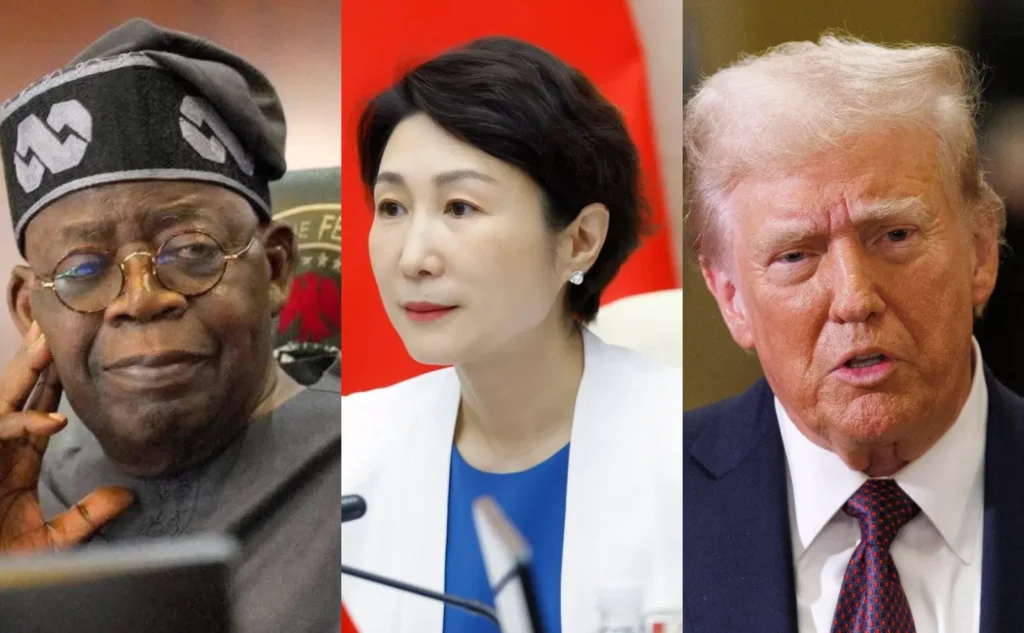
China has issued a strong diplomatic response to recent remarks by US President Donald Trump, who threatened military intervention in Nigeria over alleged religious persecution.
At a press briefing in Beijing, Chinese Foreign Ministry spokesperson Mao Ning cautioned the United States against using religion or human rights as pretexts to interfere in Nigeria’s internal affairs. She reaffirmed Beijing’s support for Nigeria’s sovereignty, security, and chosen development path.
“China firmly opposes any form of external interference under the guise of religion or human rights,” Mao said. “Nigeria’s people have the right to determine their future without coercion.”
Trump’s comments, made during a campaign rally, accused the Nigerian government of failing to protect Christians and hinted at possible sanctions and U.S. military action.
Nigerian President Bola Ahmed Tinubu swiftly rejected the allegations, reiterating his government’s commitment to protecting religious freedom and national unity.
Beyond diplomatic solidarity, analysts say China’s defence of Nigeria reflects its deepening economic interests in Africa’s most populous nation.
Nigeria remains a key partner in the Belt and Road Initiative (BRI), with Chinese companies investing heavily in infrastructure, energy, and mining projects. A Brookings Institution report identifies Nigeria as one of the top African destinations for Chinese foreign direct investment, especially in oil, gas, and solid minerals such as lithium and gold.
In May 2025, the Chinese Ambassador to Nigeria met with the Minister of Solid Minerals Development, describing bilateral mining cooperation as showing “remarkable achievements and enormous potential.”
According to Business Insider Africa, Chinese firms have invested over US$1.3 billion in Nigeria’s lithium processing industry since September 2023. These ventures align with Nigeria’s drive to diversify its economy away from oil, expand green mineral value chains, and attract technology transfer through strategic partnerships.
China’s designation of Nigeria as a “comprehensive strategic partner” underscores its long-term commitment to mutual economic growth. By opposing U.S. threats, Beijing is not only defending a partner nation but also protecting its growing investments and access to critical resources.
As competition intensifies between major powers over influence in Africa, Nigeria finds itself at the center of a global tug-of-war—between Washington’s rights-based diplomacy and Beijing’s investment-driven approach.
For now, China’s message to the U.S. remains clear: stay out of Africa’s internal affairs.