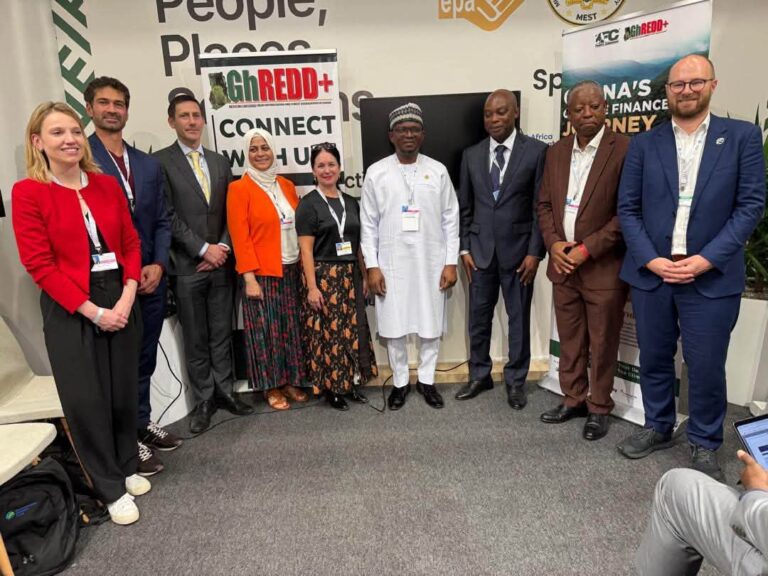
Justine Seyire Dzadzra (1st from left)
The Environmental Protection Authority (EPA) has warned that persistent myths in mining communities are undermining land reclamation efforts in Ghana’s fight against illegal gold mining.
Speaking during an engagement with The Guardian journalist Sarah Johnson and the British High Commission in Ghana, Mrs.
Justine Seyire Dzadzra of the EPA revealed that some small-scale miners believe gold deposits regenerate naturally if mined land is left fallow for a period of time.
She described this misconception as a major obstacle to proper reclamation, noting that it discourages miners from restoring degraded sites.

“This myth that gold ‘grows back’ is dangerous,” she said. “It prevents responsible environmental practices and contributes to ongoing destruction of farmlands and water bodies. Without effective reclamation, mining communities will continue to face long-term losses.”
Dzadzra explained that Ghana’s small-scale mining sector, legalized in 1989, already requires miners to post reclamation bonds and practice concurrent reclamation, similar to large-scale mining operations. However, misinformation and inadequate training continue to fuel environmentally harmful practices.
Dr. Esmond Quansah, Country Director of Pure Earth Ghana, also highlighted the need for continuous monitoring of mercury use in small-scale mining.

He called for technical support and modern equipment, such as portable XRF scanners, to detect heavy metals in soils and strengthen evidence-based policymaking.
Mr. Hobson Agyapong pointed to the partnership between the EPA, Pure Earth, and the UK Government, which has already produced a mercury and heavy metals impact assessment.

The findings revealed severe environmental consequences, including widespread farmland degradation.
The EPA stressed that addressing such myths through community education, alongside stronger monitoring and technical support, will be essential to ensuring land reclamation and building a sustainable small-scale mining sector.