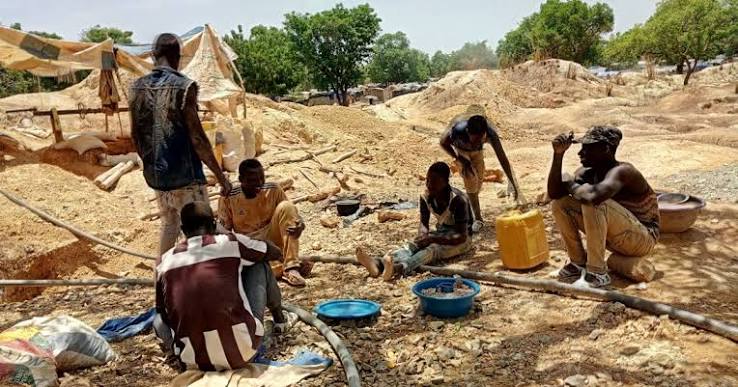
Illegal mining activity has surged directly behind the Kyebi office of environmental NGO A-Rocha Ghana in the Abuakwa South Municipality of Ghana’s Eastern Region, destroying more than 50 acres of land and placing nearby structures at risk of collapse.
The invasion, involving over 70 illegal miners operating with at least five excavators and other heavy equipment, has turned the area in Kyebi into a high-intensity mining zone, with operations continuing day and night.
The activity has generated persistent noise, dust pollution, and severe land degradation, leaving parts of the A-Rocha Ghana office and nearby private homes “hanging,” according to observers at the scene.
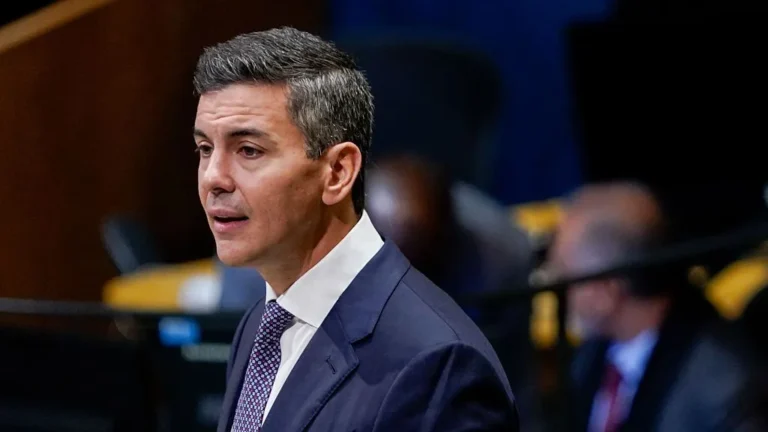
The extent of destruction shocked a visiting European Union delegation, led by EU Ambassador to Ghana Rune Skinnebach, who toured illegal mining sites in Kyebi alongside journalists and police personnel as part of an assessment of environmental governance challenges.
“So, before coming here to this forest in the Kibi area, I’d heard a lot about galamsey. Today we have visited a couple of sites, we’ve seen what it does to nature,” Skinnebach said.
“We have started to understand the complexities of the galamsey file.”
He added that enforcement gaps and governance challenges are central to the crisis, noting, “We know that there are problems with enforcing also this framework which has been laid down, and today we have seen or partly understood why.”
The ambassador warned that the environmental toll is already widespread and worsening. “We can see whole communities benefiting from but in the short term. We’ve also seen the effects it has on nature,” he said, adding that pollution of water bodies is a major concern.
“We know that it’s polluting the water bodies. 65 percent of the water bodies in Ghana are now polluted due to galamsey.”
Skinnebach also highlighted broader risks beyond the environment, linking illegal mining to health, governance, and security pressures.
“We know that it has effects on the health of the workers but also of the regular Guinean consumer. Clearly, it has implications for governance, clearly it has implications for corruption, clearly it has implications for security also,” he said.
Calling for a policy reset, he urged Ghana to move toward stronger regulation backed by enforcement. “To address a complex issue like galamsey, we need first of all we need to think long term, we need to think sustainability, we need to have regulation and we need to have enforcement of the regulation,” he said.
He further argued that global market conditions present an opportunity for reform. “Gold prices are high; we can have a regulated exploration of gold and still make a profit,” he added.
For A-Rocha Ghana, which has been at the forefront of anti-galamsey advocacy, the destruction behind its office underscores what environmental campaigners describe as an escalating national crisis—one now unfolding at the doorstep of conservation work itself.