Discussions about the depreciation of the local currency, the Cedi against the US dollar has dominated the headlines in Ghana over the past few days.
This is coming on the back of news that, the Cedi is now the worst ranked currency globally.
The Ghana Cedi continued its free fall, losing value twice on Thursday (20 October) to sell at GHC 4.50 to one US dollar.
This translated to 5.45% depreciation in a day and 17.5% in four days of the week.
It began the day at GHC 13.75 to the American ‘greenback’ but declined in value further to GHC 14.50, according to quotations by the forex bureaus.
In nominal terms, the Cedi has lost about 135% value to the world’s most important currency.
In real terms, the local currency has depreciated by about 55% to the dollar.
Currently, the average Ghanaian earns not more than GHC 2,500 per month.
According to Abdul Hayi Moomen, what this means is that exactly a year ago, the average Ghanaian used to earn “$ 416 (dollars) per month.
A year later, the average increase on the salary of the average Ghanaian was only 10 percent, which brought the average salary up to GHC 2,750.
At the moment, the dollar to cedi rate is hovering around 1:15. That then brings the average Ghanaian salary, despite the 10 percent increase, to $ 215 (dollars).
In essence, the Ghanaian worker has seen about 50 percent decrease in his/her earnings in the last 12 months.
Meanwhile, prices of “everyday” items such as (forget fuel and assume it is a problem for the rich and elite car owners), toothpaste, tomatoes, bread, sanitary pad, ‘pure water’ and even condom, have risen – continue to rise.
Ladies and gentlemen, this isn’t about politics. It is reality, Hayi Moomen concluded.
So, it was refreshing when I saw leak of an internal communication from Nestle Ghana Ltd informing workers (line managers, I hear) with GHC 7,500 to cushion them in this challenging times.
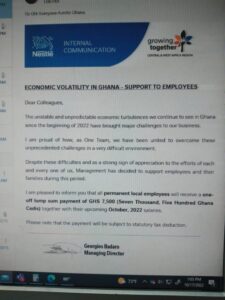
The leaked letter reads: Economic Volatility in Ghana-Support to Employees.
Dear colleagues
The unstable and unpredictable economic turbulence we continue to see in Ghana since the beginning of 2022 have brought major challenges to us as business.
Iam proud of how as one Team, we have been united to overcome these unprecedented challenges in a very difficult time.
Despite these difficulties and as a sign of appreciation to the effort of each and every one of us, Management has decided to support employees and their families during this period.
Iam pleased to inform you that all permanent local employees will receive a one-off lump sum payment of GHC 7,500(Seven Thousand, Five Hundred Ghana Cedis) together with their upcoming October 2022 salaries.
Please note that the payment will be subject to statutory tax deductions.
Signed
Georgios Badaros
Managing Director
Nestlé Ghana will pay all its local employee GHC7,500 plus their October salaries due to the current harsh economic climate.
Incredible gesture from Nestlé pic.twitter.com/fxxuaCXmMO
— Kwaku Asante (@kwakuasanteb) October 20, 2022
Well, the journalistic instinct in me did not want to just speculate, so I did the honourable thing to verify the authenticity of the leaked document.
Thankfully I had an official response from Nestle after two days. The official who called notifying me that they have receive my inquiry into the leaked document, and that they don’t want to comment on the issue.
My source within the company however tells me the decision by management has sparked some heated debate among workers, with regards to who stands to benefit and who does not. But that is my back case if that is really the case.
But, deep within me, if that is the step Nestle is taking, then that is a sign of sensitivity to the plight of their workers in these challenging times and must be emulated by other companies to lessen, the plight workers and their families are facing in these difficult times.
On this note, until employers come out with pragmatic measures to lessen the burden of the current challenges on their businesses and employees, I think the repercussion may be dire. Perhaps those who can comfortably work from home should be allowed to do so, to cut down on the cost on transportation in the face of rising fuel prices and looming hike in transport fares.
A word to the wise is enough.
Fred Dzakpata