Prof. Anthony Owusu-Ansah
The Lands Commission has initiated legal proceedings against lessees of state and vested lands who have defaulted on ground rent payments, warning that enforcement measures are expected to be fully rolled out in 2027.
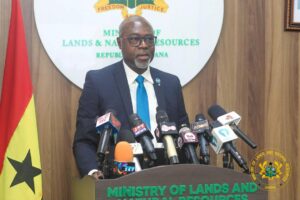
The Executive Secretary of the Commission, Prof. Anthony Owusu-Ansah, said all lessees were required to pay their annual ground rent when due, whether or not they had received a demand notice.
Speaking at a press briefing on Tuesday, October 27, he said the Commission had collected GHC40.7 million in ground rent as of August 2026, representing 90.4% of its GHC45 million annual target.
The amount collected also exceeded the GHC32.02 million recorded in 2025.
Prof. Owusu-Ansah urged defaulters to settle their outstanding payments promptly and encouraged lessees with expired leases to begin the renewal process to avoid possible legal consequences.
He said the Commission was pursuing broader reforms to modernise land administration, improve accountability and restore public confidence in the management of land in Ghana.
He highlighted the ongoing review of the 1999 National Land Policy, with a new policy expected in 2027. He also disclosed that proposed regulations for the Land Act, 2020 (Act 1036), were before Parliament for consideration.
The Commission is also expanding its Enterprise Land Information System (ELIS), which has reduced the turnaround time for official land searches from about one month to an average of seven working days in areas where the digital service is operational.
In a presentation on the reforms, the Project Coordinator of the Strategic Land Administration Reform Project (SLARP), Surv. Jones Ofori-Boadu, said the project was designed to address long-standing challenges in land administration, including fragmented records, outdated maps, manual processes and delays in service delivery.
He noted that Ghana’s most recent national topographic maps date back to 1974, highlighting the need for updated mapping and improved sharing of spatial data among public institutions.
Surv. Ofori-Boadu said the project would also support customary land secretariats, boundary demarcation and the development of government land banks for commercial agriculture.
SLARP will support the digitisation of records held by the Lands Commission and the Office of the Administrator of Stool Lands, expand land administration services to the district level, strengthen systematic land titling and develop a national cadastre.
The reforms are intended to make land administration in Ghana more transparent, accessible and efficient.