President John Dramani Mahama has announced a bold new incentive in Ghana’s war against gold smuggling: whistleblowers will now be entitled to 10% of the cash or gold recovered from any successful tip-off.
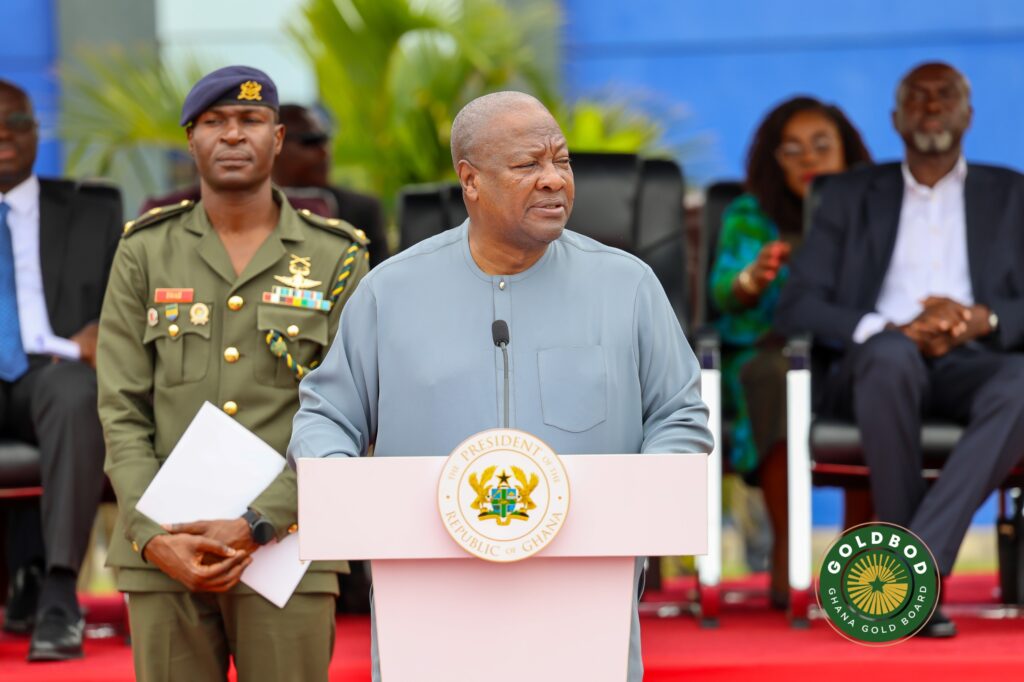
Speaking at the official inauguration of the Gold Board Task Force in Accra on Tuesday 8 July, Mahama said the new measure is aimed at mobilising public participation in the fight against illicit gold trade, which has cost Ghana an estimated $11.4 billion in lost revenue over the last five years.
“This is the sweetest part,” Mahama declared, pausing for emphasis. “If you blow the whistle on anybody and gold or cash is retrieved, you will get 10% of the value—gold and cash.”
The reward scheme is expected to motivate citizens, including workers in the mining sector and border areas, to report suspicious activities tied to illegal gold trading and smuggling. With the scale of losses Ghana faces annually due to undeclared exports and black market transactions, whistleblowers could earn tens or even hundreds of thousands of dollars depending on the size of recoveries.
Whistleblower opportunity
Mahama cited recent findings that revealed a 229-metric ton discrepancy between Ghana’s official gold exports and the gold recorded as imported by trading partners — a gap valued at over $11.4 billion over five years. “This will not continue,” he stressed, positioning the whistleblower reward as a tool for closing this leak in national revenue.
The newly formed Gold Board Task Force, under the Ghana Gold Board (GoldBod), is the operational backbone of this enforcement effort. Comprised of personnel from national security, the military, and other law enforcement agencies, the task force has undergone intensive vetting, polygraph tests, anti-corruption training, and legal orientation.
All officers will operate under strict oversight, wear body cameras on duty, and be GPS-tracked in real time. No operation will proceed without a written warrant from the CEO of the Gold Board.
Zero Tolerance for Abuse
While encouraging public participation, Mahama also issued a stern warning to task force members and gold smugglers alike.
“Abuse of authority will not be tolerated,” he said. “Any officer found engaging in misconduct will face immediate sanctions, including dismissal, prosecution, and loss of entitlements.”
Under the Gold Board Act (Act 1140), unlicensed gold trading is banned and foreigners are prohibited from buying gold at the source. Violators face fines of up to GHS 2.4 million, 5 to 10 years in prison, or both. However, Mahama clarified that foreign companies can apply to the Gold Board for licenses to participate in gold offtake, refining, and value addition under regulated terms.
Mahama emphasised that the Ghana Gold Board is not just a gold buyer and exporter, but a regulatory institution with a responsibility to ensure traceability and transparency across the gold value chain.
“Beyond foreign exchange and revenue generation, the Gold Board is committed to traceability,” he stated, noting the Board’s role in sanitising the sector and helping Ghana benefit more from its mineral wealth.
With the 10% reward now in place, the government is betting on citizen action as a powerful tool in turning the tide against smuggling. For many Ghanaians, Mahama’s message is clear: if you see something, say something — and you might just strike gold.