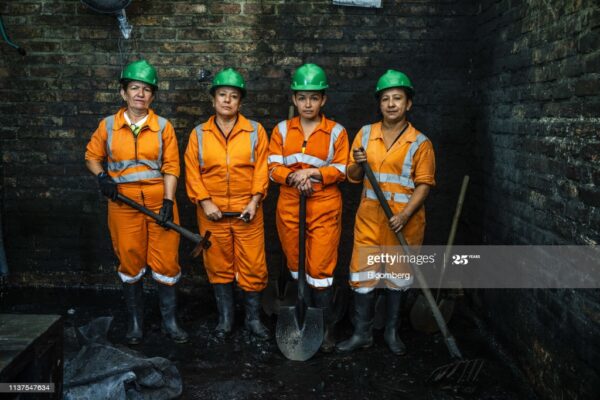
Women at a mining site
When it comes to the issue of representation of female artisanal and small-scale miners (ASMs), there are a few recurring trends that are key to identifying how female miners are seen in relation to the industry.
“For sure there is a strong narrative in some contexts that link real concerns about women’s health to claims about women’s moral well being, and the wellbeing of their children in relation to their mining activities,” Doris Buss, professor in law and legal studies at Carleton University, Canada, says, but some policies could be standing on shaky ground.
One of the most striking examples for this is the case of a ministerial order In Kinshasa, Democratic Republic of Congo (DRC), which banned pregnant women from gold mining, an example that Buss and Rutherford have explored as part of their recent research. The reason for the ban was the link to the narrative that women and their children are particularly at risk when present at a mining site.

The company’s repairs centre was built in 2010 to offer repair, rebuild and technical fault-finding services to industries including transportation,…Read More
Female artisanal and small-scale miners battling the stigma
The DRC mining regulation was first introduced in February 2012 and specified that no pregnant women should be allowed to work in mining supply chains, not regarding the minerals mined there. However, this case exposed the need to look at the specific conditions of mining on an individual basis, to assess the possibility of risks connected to mining.
“There are a lot of myths or easy assumptions that really need unpacking about women, children, and mining. So, in the case of pregnancy, the assumption that’s often made is that artisanal mine sites use mercury for gold mining. But while mercury may be used by all kinds of gold miners, but it’s not necessarily used in all forms of gold mining, nor in all mining roles. So, there isn’t necessarily a risk to women or to their children,” Buss says.
In cases like this one, existing policies could be heavily based on prejudice and policymakers could be generalising the mining industry and women’s experiences.
“Secondly, women in DRC that we spoke to about the ban said that for them, some of the physical challenges of the mining work are actually less than the physical challenges they face in agriculture. So, while they are pregnant, mining may actually be easier for them. [This is because] there are different roles within mining that women do and some of these are not necessarily more challenging than agriculture, which, if you ban women from the mine sites, is in most cases the next available livelihood to them,” Buss explains.
She adds that this issue is connected to “the third assumption that’s often made in relation to pregnancy – that women bring children to the mine because they’re the primary caregivers and often have children. But again, that also needs unpacking”.