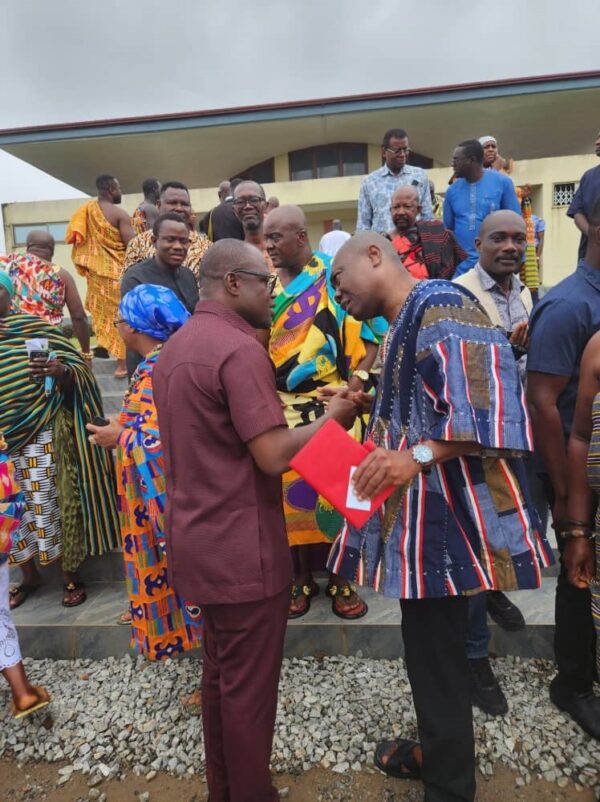
CEO Minerals Commission Martin Ayisi (right)
The Minerals Commission of Ghana has initiated a comprehensive review and update of the country’s 2014 Mining Policy and legal framework, aiming to modernize the sector and align it with the Sustainable Development Goals.
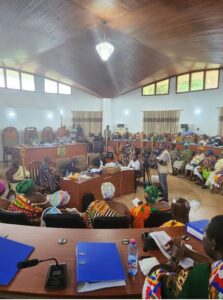
As part of the ongoing stakeholder engagement process, a high-level delegation led by the Chief Executive Officer of the Minerals Commission, Mr. Martin Kwaku Ayisi (Esq), and Prof. Jerry Samuel Yaw Kuma, Advisor to the Minister of Lands and Natural Resources, met with the Central Regional House of Chiefs on July 9, 2025, to discuss the proposed amendments.
In his welcome address, Odeefuo Amoakwa Buadu VIII, President of the Central Regional House of Chiefs and Omanhene of the Breman Traditional Area, thanked the delegation for engaging with and educating the House on the mining policy and legal amendments. He stated that such consultations cannot be overemphasized and urged Nananom to contribute their inputs to enhance the work of the policy review committee.
So far, the review committee has held consultations with key stakeholders, including the Ghana Chamber of Mines, civil society organizations, academia, and research institutions. The overarching goal is to ensure that the benefits of mining are equitably distributed while promoting environmental sustainability and social responsibility.

Mr. Benjamin Aryee, former CEO of the Minerals Commission and former Advisor to the Minister, presented the review of the 2014 Mining Policy. He highlighted new provisions, including the Green/Critical Minerals Policy, emerging global trends such as climate change, Environment, Social, and Governance (ESG) standards, and government initiatives like the introduction of Cooperative Mining and the recategorization of mining with the creation of a medium-scale category. Mr. Aryee reiterated some of the challenges facing the mining sector and outlined strategic recommendations based on the draft policy. These include the establishment of a centralized gold trading institution, such as a Gold Board, to enhance transparency and accountability in the gold value chain; decentralization of the Minerals Commission to improve support for mining communities; strengthening community relations to reduce conflicts; advancing local content and participation; enhancing health and safety standards; and promoting fiscal transparency through reforms for fair revenue distribution.
The Commission’s Manager of Legal, Mr. Josef Iroko, discussed the current state of mining laws and regulations, as well as administrative and regulatory guidelines. He stressed the importance of Parliamentary ratification of mining leases and elaborated on the rights and responsibilities of District Mining Committees in overseeing activities within their jurisdictions. Mr. Iroko also highlighted the critical role of chiefs and traditional leaders as allodial owners of the land, emphasizing their entitlement to compensation under Ghana’s mining laws.
Mr. Ayisi provided an overview of the Minerals and Mining Law, Act 703 (2006), and outlined significant proposed amendments. He introduced the proposed Community Development Agreement (CDA), which would allocate 1% of mining companies’ revenue to support equitable community development. He also announced the introduction of a medium-scale mining category to bridge the gap between small-scale and large-scale operations and emphasized the need to review and renegotiate existing mining contracts to ensure fairness and alignment with national interests.
He stressed that the updated policy and legal framework would serve as a foundation for a more inclusive, transparent, and sustainable mining sector. Mr. Ayisi further explained that after a mining lease or license is issued, the mineral rights holder must obtain an Environmental Permit from the Environmental Protection Agency and an Operating Permit from the Chief Inspector of Mines before commencing operations. He urged the Chiefs to verify any documents submitted by prospective mineral rights holders with the Commission and noted a proposal to limit prospecting licenses to a maximum of nine years and mining leases to fifteen years.
During the discussion session, the House of Chiefs recommended that all Mining Concession Notices be served on the Traditional Council, represented by the President of the House, the Paramountcy, and the local Chief of the designated area. They inquired about the difference between prospecting and reconnaissance mining and raised concerns about illegal sand-winning activities in the region. Mr. Ayisi clarified that salt is a mineral regulated under the mining law and assured the House that a comprehensive plan would be developed to engage communities involved in salt mining.

The CEO encouraged the House of Chiefs to review the proposed amendments and submit their recommendations within two weeks for consideration by the Review Committee. He concluded by reaffirming that as Ghana positions itself as a leader in responsible mineral resource management, the proposed reforms are expected to significantly enhance the sector’s contribution to national development.
In response, Odeefuo Amoakwa Buadu VIII commended the CEO and his delegation for their commitment to transforming the mining sector through a consultative and inclusive process and pledged the House’s full support in achieving this vision.
Also present at the gathering were the Central Regional Minister, Eduamoah Ekow Panyin Okyere; Mr. Nelson Ahedor, Director of Small Scale and Industrial Minerals; and Dr. Ahmed Tijani, Manager of Corporate Affairs and Information Technology at the Minerals Commission.