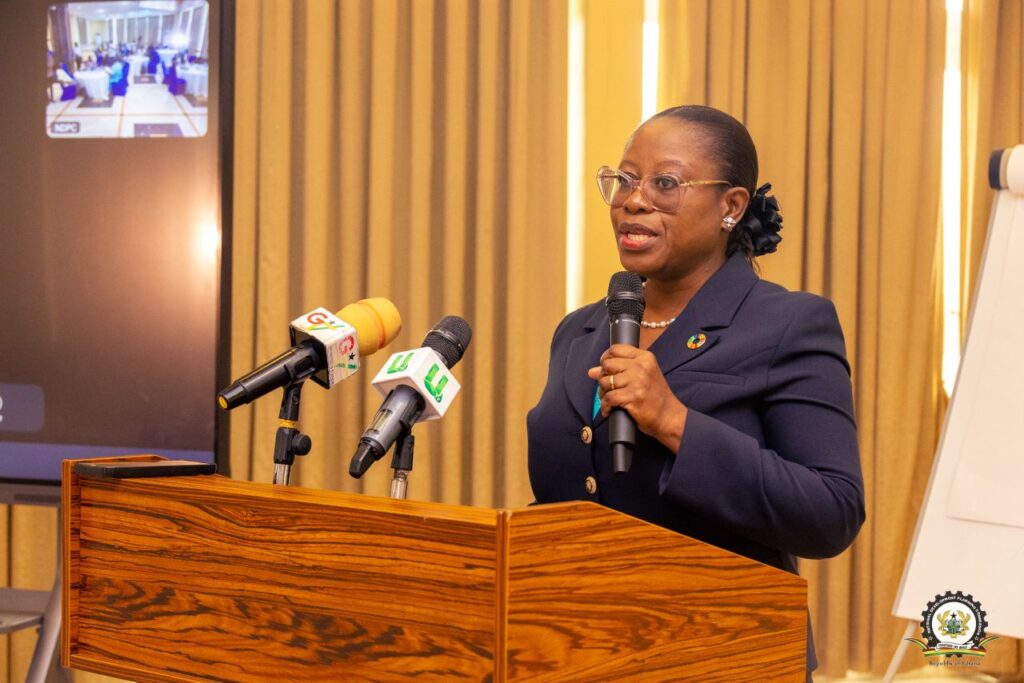
Dr Audrey Smock Amoah,
The National Development Planning Commission (NDPC) has reaffirmed its commitment to transparency and evidence-based planning as it presented Ghana’s 2024 National Annual Progress Report (APR), the third under the Agenda for Jobs II (2022–2025) framework.
Speaking at the launch of the report in Accra on Monday (13 October), the Director-General of the NDPC, Dr. Audrey Smock Amoah, said the report offers a comprehensive assessment of Ghana’s development performance across six key dimensions — economic, social, environment, infrastructure and human settlements, governance, corruption and accountability, emergency planning and COVID-19 response, and implementation, coordination, monitoring, and evaluation.
Dr Amoah noted that the 2024 APR, which is the 23rd in the series since 2002, “reflects both resilience and progress, alongside persistent challenges that require our collective and urgent attention.”
She outlined the main objectives of the report, including assessing whether national targets are being met, identifying achievements and constraints, documenting lessons learned, improving service delivery and fiscal planning, and demonstrating accountability to stakeholders.
The NDPC Director-General acknowledged recurring challenges in data collection and quality, including non-availability of timely and accurate data, inconsistencies across institutions, delays by Ministries, Departments and Agencies (MDAs), and limited resources for monitoring and evaluation.
However, she said several corrective measures were implemented to improve data reliability — including sourcing additional data from institutions such as the Bank of Ghana, Ghana Statistical Service, Ministry of Finance, and the World Bank, as well as involving more agencies in validation exercises and peer reviews by technical experts.
Despite recorded progress, Dr. Amoah said the report highlights persistent fiscal pressures, inflationary trends, youth unemployment, gender inequality, infrastructure deficits, environmental degradation, and weak institutional coordination.
“These are challenges we must confront collectively as we approach the final year of the Agenda for Jobs II,” she emphasized.
Dr. Amoah called for renewed national focus on key priorities to sustain Ghana’s development momentum, especially as 2025 marks both the final year of Agenda for Jobs II and the first year of President John Mahama’s tenure.
“Our focus must now be on sustaining economic momentum through enhanced revenue mobilization and agricultural modernization; bridging social gaps with gender-responsive and youth-focused policies; prioritising infrastructure investment to complete legacy projects; and strengthening governance through decentralization and institutional accountability,” she stated.
Concluding her remarks, Dr. Amoah urged all stakeholders — including government agencies, civil society, and the media — to engage constructively with the report’s findings.
“Let us use this evidence to foster a robust national dialogue and collaborate with renewed vigour towards the realisation of an inclusive, sustainable, and prosperous Ghana for all,” she said.