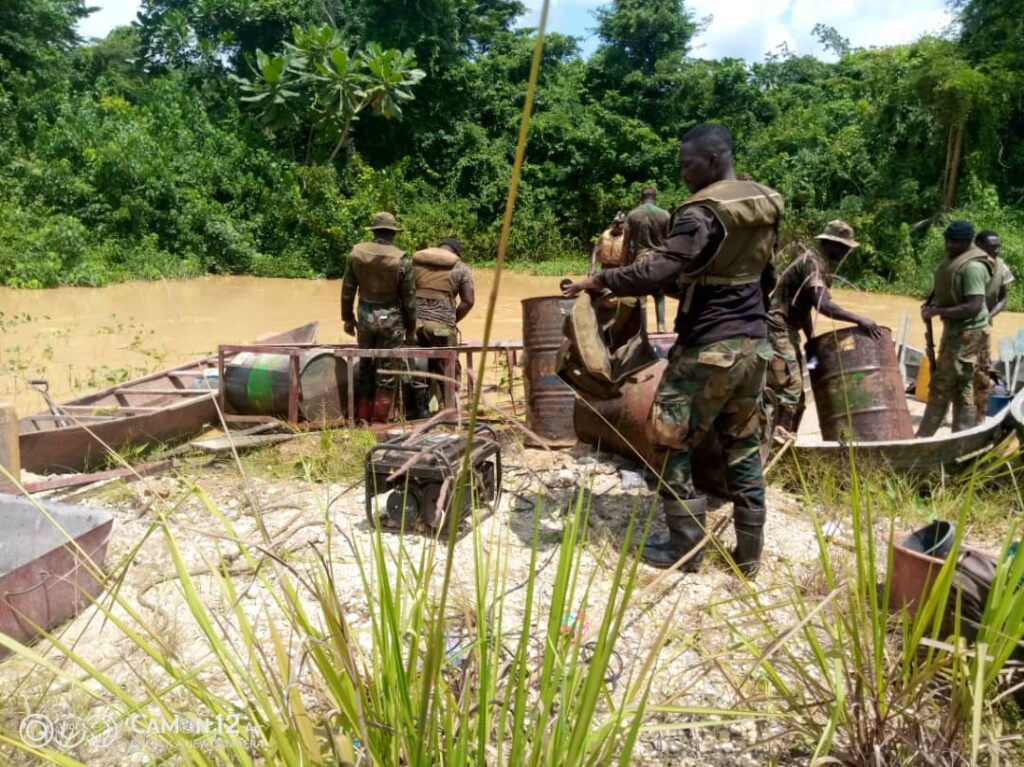
Military men at illegal mining site in Ghana
A groundbreaking new study published in The Extractive Industries and Society journal has raised serious concerns about the unintended consequences of using military force to combat informal mining, particularly in Ghana.
Led by Dr. Kenneth Joseph Bansah of Missouri University of Science and Technology and a team of Ghanaian researchers, the study reveals that rather than curbing illegal mining—commonly referred to as “galamsey”—military interventions may be intensifying environmental degradation.
The study, titled “Fighting Fire with Fire: How Military Actions Expand Environmental Destruction in Informal Mining”, finds that military operations often displace miners rather than deter them. In response to security crackdowns, miners adopt evasive strategies, relocating to previously undisturbed areas and continuing operations—often with increased speed and mechanization. This pattern, the study notes, significantly enlarges the environmental footprint of informal mining activities.
Drawing on extensive fieldwork conducted in seven mining communities in Ghana’s Tarkwa-Nsuaem Municipality, the researchers introduce a new analytical tool—the Intervention and Environmental Expansion (IEE) Framework. This model explains how state interventions, despite aiming to protect the environment, may paradoxically trigger more harm by pushing mining into ecologically sensitive zones.
“Military intervention is intended to be a deterrent, but our findings show that it often results in miners simply shifting location, spreading destruction further,” said Dr. Bansah. “We must rethink these strategies if we want sustainable, lasting results.”
The study highlights how these interventions conflict with several United Nations Sustainable Development Goals (SDGs), particularly those focused on environmental protection, clean water, climate action, and sustainable land use. The report suggests that militarized approaches not only fail to solve the problem but may also undermine development and conservation efforts.
Despite decades of military involvement in Ghana’s informal mining sector, environmental damage remains rampant. Rivers are polluted, forests are cleared, and farmlands are destroyed, with little evidence of long-term success. The authors call for a shift from force-based solutions to inclusive strategies that emphasize regulation, formalization, community engagement, and sustainable livelihoods.
The paper comes at a time when many governments across Africa and Latin America are doubling down on enforcement tactics to tackle illegal mining. It warns that without addressing the socio-economic drivers of informal mining—such as unemployment, poverty, and weak regulatory systems—military solutions will continue to fall short.
The authors urge policymakers to use the IEE Framework to assess the broader impact of their interventions and adopt more holistic approaches that align with both environmental goals and local development needs.
The full article is available in the December 2025 edition of The Extractive Industries and Society.