Victoria Hamah
The narrative of my public life over a decade, unfortunately, has been reduced to scandal, a framing that is analytically convenient rather than empirically faithful.
It obscures a more instructive reality: my trajectory has been shaped not by dismissal, but by the response of power when a woman refuses to self-diminish. My public career as a student leader, gender activist and Deputy Minister were met with sustained challenges to legitimacy that bore little relation to competence or mandate, and much to entrenched gendered norms governing authority, visibility, and control.
My physical appearance over the years has been a sight of public scrutiny, my confidence recoded as excesses, and my political presence constrained by a culture uneasy with women who occupy power without deference.
When my public controversy emerged, the institutional response was swift, moralistic, and largely indifferent to context. The language of accountability was mobilised to justify strict censure and sanction, while structural hypocrisy remained uninterrogated. In that moment, the political system revealed a deeper pathology: a preference for spectacle over justice, and a willingness to sacrifice women to preserve institutional comfort rather than confront its own contradictions.
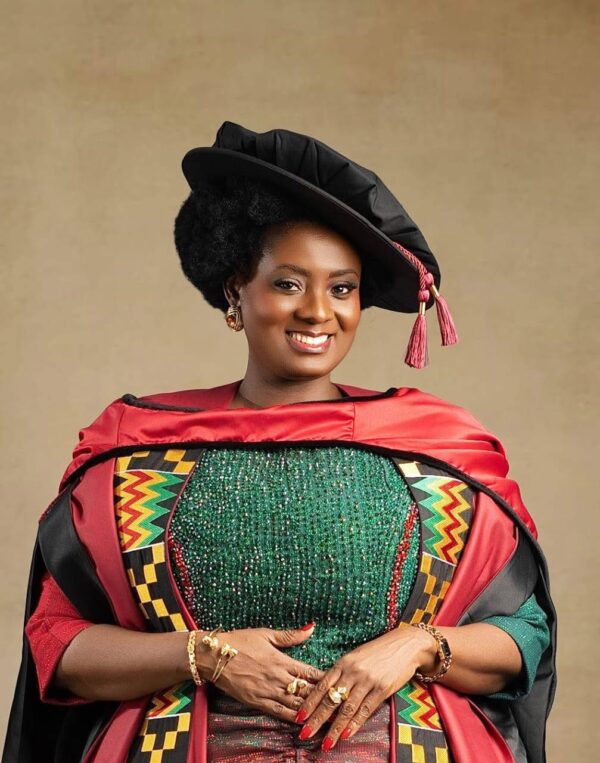
My departure from office did not signal retreat, but a critical reckoning. I rejected the assumption that removal from executive power constitutes political erasure. Instead, I turned to systematic inquiry as the continuation of my political engagement through scholarly means. This intellectual turn led me into doctoral study, not as an escape from politics, but as a deliberate effort to interrogate the institutional, cultural, and power-laden conditions that shape leadership, morality, and exclusion in public life.
My doctoral dissertation, Gender Asymmetry in Ghana’s Parliamentary Committees: A Critical Analysis of Women’s Representation and Legislative Influence, examines the gendered dynamics embedded within Ghana’s parliamentary committee system. It analyses how institutional design, political culture, and asymmetrical power relations condition women’s participation and constrain their legislative influence.
The study foregrounds the intersection of public morality, patriarchy, and institutional practice, demonstrating how women in leadership are disproportionately exposed to scrutiny, discipline, and displacement. This work is not autobiographical reflection disguised as scholarship; it is a rigorously grounded political intervention informed by lived experience and sustained empirical analysis.
Beyond academia, my commitment to women’s leadership predates and transcends my doctoral journey. I founded the Progressive Organisation for Women’s Advancement (POWA) from the conviction that women’s political participation must be actively protected within structurally hostile environments. My experiences in government did not give rise to POWA; they sharpened my understanding of its necessity. Through advocacy, mentorship, leadership development, and institutional engagement, POWA works to ensure that women are not merely included in public life, but safeguarded within it.
My intellectual and professional trajectory is not oriented toward rehabilitation or redemption, but toward transformation. I occupy the position of a scholar-practitioner who understands power both from within institutional authority and from its margins.
My future work lies in shaping governance debates, influencing policy, mentoring women leaders, and contributing to a political culture capable of recognising accountability without cruelty and leadership without gendered punishment. I have learned that in politics, falling is not synonymous with failure; often, it signals that one has exposed what the system would rather leave unseen. That exposure, in itself, is a form of power.
I hope my experience in public life encourages young women to challenge the myth that women cannot succeed in politics or any endeavour, and instead reveals that such beliefs persist not because of facts, but because societies have failed to dismantle the structural inhibitions that constrain women.
Victoria Hamah