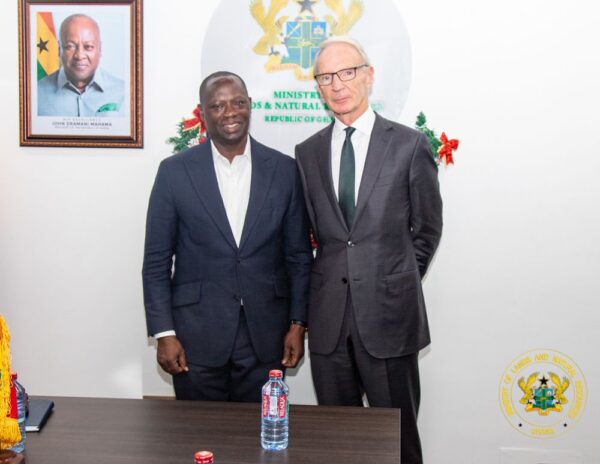
Emmanuel Armah-Kofi Buah (left) and David Tait
Ghana’s Responsible Cooperative Mining and Skills Development Programme (rCOMSDEP) has received strong international endorsement from the World Gold Council (WGC), positioning the country as a global reference point for reforming artisanal and small-scale mining (ASM).
At a high-level engagement in Accra on Monday, January 5, 2026, the Chief Executive Officer of the World Gold Council, David Tait, described rCOMSDEP as a robust, well-designed framework capable of serving as a blueprint for formalising ASM operations worldwide.
He said the initiative responds directly to the global gold industry’s demand for traceable, responsible, and sustainable supply chains.

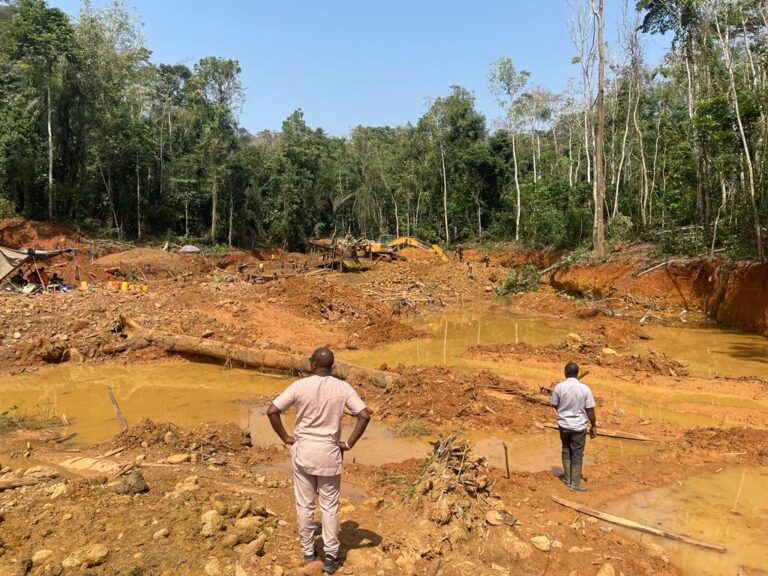
The engagement, hosted by the Ministry of Lands and Natural Resources, focused on Ghana’s efforts to establish a fully traceable gold value chain through regulated community processing plants and official buying channels—an approach aimed at eliminating illegal mining while improving livelihoods in mining communities.
Minister for Lands and Natural Resources, Emmanuel Armah-Kofi Buah (MP), said rCOMSDEP fits squarely within government’s broader strategy to formalise the ASM sub-sector, promote responsible mining practices, and enhance value addition in Ghana’s mineral resources.
According to the Minister, the programme is designed to channel gold production through transparent and accountable systems, dismantling the informal and illicit trade networks that have long plagued the sector.

Mr. Tait noted that the World Gold Council’s interest in Ghana’s model is driven by its potential to standardise gold sourcing from traceable and responsibly produced sources suitable for international refineries. He added that the programme also has the capacity to attract investment into the ASM sub-sector by improving governance, transparency, and market confidence.
The partnership between Ghana and the World Gold Council is anchored on the development of an integrated gold value chain built on three pillars: traceability from mine to market, centralized community processing plants to aggregate and monitor production, and the use of regulated gold buying channels.

Both parties agreed on a clear implementation roadmap, including the establishment of a joint technical working team to oversee the rollout and ensure transparency. The first community processing plants are expected to become operational within six months of funding confirmation.
The endorsement by the World Gold Council marks a significant milestone in Ghana’s mining reform agenda, underscoring the country’s growing leadership in responsible ASM development and its potential to influence global best practices in the gold industry.