Emmanuel Armah-Kofi Buah
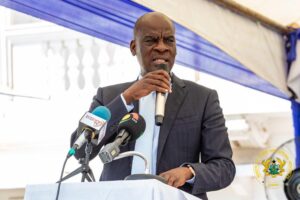
Ghana’s fight against illegal mining continues with renewed urgency as the Minister for Lands and Natural Resources and Acting Minister for Environment, Science and Technology, Emmanuel Armah-Kofi Buah, delivered a forceful call to action at the Chief Justice’s Mentorship Programme.
Addressing judges, lawyers and students, the Minister painted a stark picture of Ghana’s natural heritage—once defined by lush forests, fertile farmlands and pristine waters—now scarred by what he described as “gaping, bleeding holes in the earth.” He warned that illegal mining has stripped communities of their health, dignity and the future of their children.
“The fight against galamsey is not just an environmental campaign,” the Minister declared. “It is the ultimate test of our rule of law, our national conscience and our commitment to justice for posterity.”
He reaffirmed Government’s resolve to reclaim degraded lands, restore polluted rivers, and return Ghana’s forests to green and its waters to blue.
According to him, this commitment is being driven by a five-pronged, holistic strategy anchored on collaboration, transparency, land reclamation, the provision of alternative sustainable livelihoods for mining communities, and strengthened law enforcement.
Detailing far-reaching reforms, the Minister disclosed that Government is overhauling the mining licensing regime to eliminate corruption and opacity, decentralising permit systems to improve access to legality, and sanitising both small- and large-scale mining operations.
One of the most decisive interventions, he said, is the nationwide tracking and geofencing of earth-moving equipment. “Today, every excavator imported into Ghana is tracked and geofenced. If it moves outside its approved jurisdiction, it is demobilised,” he noted, revealing that more than 1,200 excavators are already under surveillance.
Turning to the students, the Minister urged them to see themselves as future custodians of environmental justice. “You will be the interpreters, defenders and innovators of these laws,” he told them.
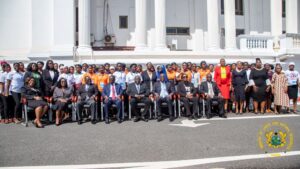
In a keynote address, the Chief Justice of Ghana, Justice Paul Baffoe-Bonnie, threw the full weight of the judiciary behind the environmental agenda, describing justice and environmental protection as inseparable.
“The judiciary’s commitment to justice cannot be complete if we ignore the environment,” he said. “For justice to be sustainable, it must protect nature, ensure equitable use of resources and safeguard the wellbeing of future generations.”
He noted that courts worldwide are increasingly dealing with cases involving illegal mining, pollution, land degradation and water rights, and that Ghana’s judiciary is no exception.
In a concrete demonstration of action, the Chief Justice announced that three High Court judges have been specially assigned to handle cases arising from NAIMOS and other state-related environmental matters, with dedicated courts expected to become operational early next year.
He also reaffirmed the judiciary’s commitment to nurturing the next generation through justice clubs and mentorship programmes. “We want green schools, clean communities, classrooms where environmental education is a daily habit, and young people who demand accountability,” he said.
Justice Baffoe-Bonnie concluded with a strong message: the protection of Ghana’s environment is not optional—it is a shared legal duty, a moral obligation and a legacy that must endure.
The President of the Ghana Bar Association, Efua Ghartey (Esq.), also called on the Ministry of Education to reintroduce Civic Education into the school curriculum to instil environmental stewardship in children from an early age.