The Environmental Protection Authority (EPA) has launched the National E-Waste Collection Drive Initiative as part of efforts to strengthen Ghana’s response to the growing threat of electronic waste and promote circular economy practices.
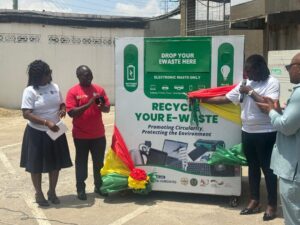
The initiative, unveiled in Accra to commemorate International E-Waste Day 2025 under the global theme “Recycling Electronics for a Sustainable Future,” seeks to mobilize citizens, businesses, and communities to adopt responsible e-waste management practices and participate in recycling efforts.
Addressing the launch on Tuesday 21 October, the Acting Chief Executive Officer of the EPA, Prof Nana Ama Browne Klutse said the initiative represents “another step in our quest to protect the environment, safeguard livelihoods, and achieve the Sustainable Development Goals.”

“We are not here for ceremony but for a cause that connects every one of us — how we manage what we no longer need, and how that choice defines the future of our planet,” the EPA boss said.
Ghana’s rising E-waste challenge
Citing findings from the 2024 National E-Waste Inventory Report, the EPA noted that Ghana generated approximately 650,000 tonnes of e-waste in 2023, equivalent to 19.24 kilograms per person — a nearly fourfold increase since 2009. The report projects that the figure could soar to 2.8 million tonnes by 2040 if urgent action is not taken.
Globally, e-waste generation has reached an estimated 62 million metric tonnes annually, with less than 20 percent being formally recycled. The rest often ends up in landfills or handled unsafely, releasing harmful toxins into the environment.
Building a sustainable recycling ecosystem
The EPA highlighted ongoing initiatives under the World Bank-funded Africa Environmental Health and Pollution Management Programme (AEHPMP) to establish modern e-waste collection, dismantling, and refurbishment centres in Accra, Koforidua, and Tamale. These facilities, when completed, will serve as regional hubs for safe recycling, repair, and materials recovery.
The EPA boss emphasized that these interventions will “create green jobs, enhance local technical skills, and strengthen Ghana’s industrial circularity.”
The agency also recalled Ghana’s pioneering role in legislating Extended Producer Responsibility (EPR) through the Hazardous and Electronic Waste Control and Management Act, 2016 (Act 917), now consolidated under the Environmental Protection Act, 2025 (Act 1124) and L.I. 2250. This framework introduced the eco-levy on imported electrical and electronic equipment (EEE) and tyres to fund environmentally sound recycling and disposal.
Public drop-off points
A major highlight of the launch was the announcement of a network of public e-waste drop-off points, established through collaboration among the E-Waste Fund, GIZ Ghana, and Melcom Ghana Limited.
Under the initiative, ten branded collection containers will be installed at key shopping and commercial centres — including Melcom North Industrial Area, Melcom Madina, and Melcom Spintex (Flowerpot) — to make e-waste disposal more accessible to the public.
“The next time you replace your phone or microwave, will you throw it away, or drop it off to be recycled responsibly?” the Acting CEO urged.

The EPA called on all Ghanaians to actively support the initiative, stressing that the success of the campaign depends on collective responsibility and behavioural change.
“Let this launch be the beginning of a national movement — one that teaches responsibility, inspires innovation, and creates green jobs for generations to come,” the CEO said.
“If it has a plug or a battery, it can and should be recycled.”
In closing, the EPA extended appreciation to the Ministry of Environment, Science, Technology and Innovation (MESTI), GIZ Ghana, the E-Waste Fund Administration, and Melcom Ghana for their collaboration and commitment to advancing Ghana’s e-waste management and circular economy agenda.