On January 21, 2022, the then Vice President of Ghana, Dr Mahamudu Bawumia, promised (archived here) victims of the Appiatse explosion that the government would be fully responsible for all their medical bills and “every intervention associated with their recovery.” Nearly four years down the line, the promise appears to have been little more than political rhetoric.
Many victims are still living with the effects of the blast, yet they have been left without access to life-saving medical care because they cannot afford the cost of treatment.
Cecilia Abban is a seamstress who resides in Appiatse. All she remembers on the fateful day of the blast was waking up in the hospital with excruciating pain. She later learned from doctors that fragments from the explosion had left her with pieces of metal in her uterus.
Despite several surgeries and purchasing expensive medications, she has seen no relief. Now, she needs the very support the government provided to set her firmly on the path to recovery.
“Despite the fragments having been washed out of my womb completely, I still experience some pain,” she explained.
Before the explosion, she would carry her sewing machine around the village to mend clothes. In her spare time, when not hawking, she sewed for women in the community. That is how she eked out a living, but the explosion has changed that reality to one she is struggling to live with.
Cecilia is unable to walk distances she used to, she claimed. “The shorter the distances, the less likely it is to meet potential customers.”

Cecilia holds one of the fragments retrieved from her uterus. Photo credit: Francis Torto
Cecilia is not the only resident of Appiatse who has been left on their own. Patience Baidoo is another victim. She was buried under the rubble for hours after the explosion, leaving her with impaired vision in one eye and respiratory problems.
She can hardly earn a living at the relief camp because she can only walk a few steps at a time. She now relies on petty trading and money earned by her young children, who run errands for people to support the family.
This is not the only nightmare she has to deal with as a result of the explosion. One of her children, Kate Afranie, was flown to Accra after the explosion and admitted to a major hospital for injuries sustained in the blast.
But her ill health has not stopped her from helping her mother run the household. From doing petty household chores to keeping up with her schoolwork, the 14-year-old continues to hold on to hope for a better life.
Her story dovetails into another survivor story. 19-year-old Sadat Sule spent months at the relief camp waiting for government support for his medical treatment. Sule was lifted in the explosion and landed on a hard surface with his belly split, exposing his innards. He eventually succumbed to his condition after months of begging for support.
He died with his dreams and aspirations unfulfilled. Aside from the pledge made to the people regarding their health, accommodation became another broken promise they lived with every day.
The Darkest Day at Appiatse
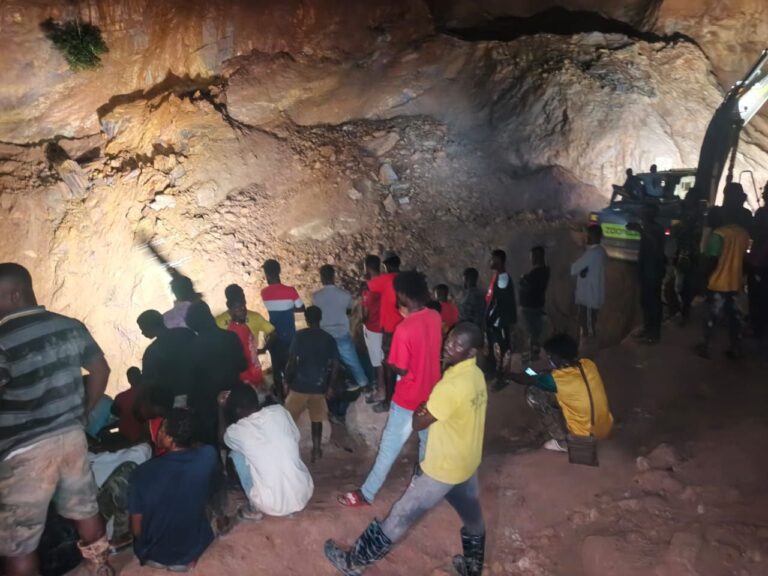
January, 20, 2022. On that Thursday afternoon, a Maxam Ghana Limited truck carting explosives from Tarkwa to Chirano mines in the Western Region of Ghana crashed into a motorcycle at Appiatse. The truck reportedly caught fire, prompting townsfolk to mitigate the situation. Then, the truck exploded.
Thirteen people died directly from the impact, while several others were seriously injured. 660 households were affected. Only a small fraction of buildings in the community could be salvaged. The rest were flattened, with some surviving only on weak pillars.
The government of Ghana, through the Ministry of Lands and Natural Resources, fined Maxam Ghana Limited $6 million: $1 million in administrative fines and $5 million for damages and support for victims.
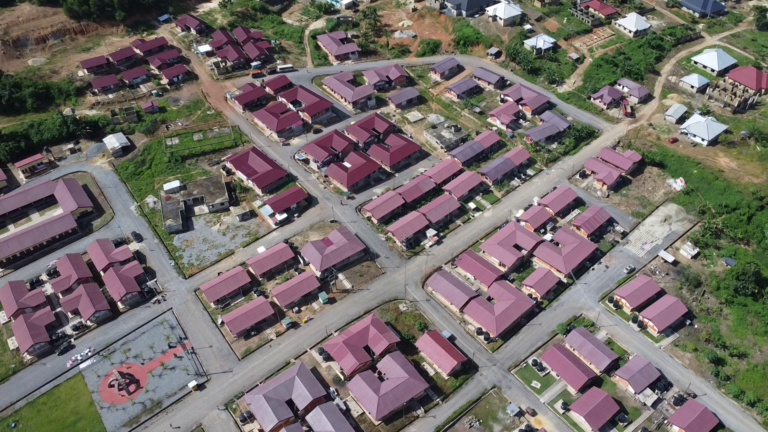
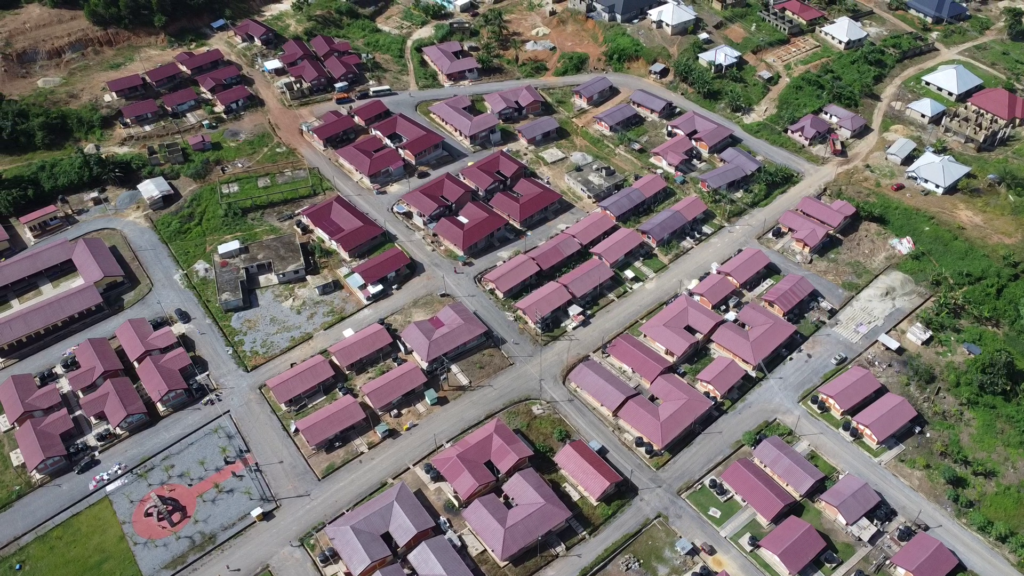
The government of Ghana set up a fund for victim support and rebuilding the village. Phase 1 was for constructing new buildings, and Phase 2 was for repairing less damaged buildings at the fringes.
The destroyed village of Appiatse was planned to be rebuilt in two forms. One part was to rebuild destroyed houses, and the other was to renovate about 50 houses that had sustained significant damage.
The government rebuilt 124 homes in Phase 1, consisting of 41 one-bedroom units, 35 two-bedroom units, 23 three-bedroom units, 15 four-bedroom units, 8 five-bedroom units, and one each six- and seven-bedroom unit. However, residents complain that they are not well compensated for their homes.

2-bedroom unit at Appiatse Phase 1. Photo credit: Francis Torto
So has the government honoured its promise to the victims?
Benjamin Nkrumah lives in Phase 1 with his family. He strongly believes his father was shortchanged in the allocation of buildings in Phase 1.
“My father had a nine-bedroom house before the disaster, the majority of which were rented out, but he was only given two units comprising a four-bedroom and a three-bedroom,” he said.
The Nkrumah family is not alone in this regard. While other residents report similar stories of being shortchanged, some bemoan the loss of extra income they made from renting rooms out to people who came to mine in and around the area before the blast.
Beyond the loss of revenue, residents of Phase 1 face dilapidated buildings and sanitary challenges.
At the extremities of Phase 1, some buildings have exposed bricks wearing out. Cement platforms around some buildings have caved in, and sewerage lines are exposed.
The chairperson of Appiatse’s residents’ committee, Enoch Nketia, says that residents of Phases 1 and 2 received cash aid from the government to support the rehabilitation of their homes. Some received as little as GHS 200, while others received GHS 50,000, depending on the repair work the resident had to do on the property. These amounts of money, according to the chairman, have been woefully inadequate.
“I was given GHS 50,000, but it was no match for the GHS150,000-plus I spent on renovations,” he admitted.
But even with construction and renovations in Phases 1 and 2, the new houses could only accommodate a fraction of the over 800 townsfolk, leaving 69 households at the appalling relief camp.
The relief camp consists of several unfinished buildings made of unplastered cement blocks, originally intended to resettle over 2,500 residents from Dumasi in the same district (Prestea-Huni Valley).

Appease Relief Camp. Photo credit: Francis Torto
However, the buildings were leveraged by the government to shelter the displaced residents of Appiatse after the tents provided by the National Disaster Management Organisation (NADMO) as relief were rendered obsolete by rains.
The only relief that keeps them going is the hope of a better future someday. This is because their woes are linked not only to the explosion’s effects but also to environmental factors.
The camp faces extreme challenges regarding potable water. Relief campers, with support from benefactors, raised funds to sink a borehole to serve the camp.
Walking to the nearest source of water was time-consuming and strenuous for the people, especially those who still suffer from the physical consequences of the explosion, thus necessitating a borehole.
Residents fetch buckets of water from the borehole each day for their domestic chores. But this water is feared among the campers.
Their pans, pots, and buckets have become laced with a reddish-brown hue, similar to rust, after storing the camp’s water in them over time.
Their fears escalated when they started using the water for cooking. Plantain and rice, when put in the water, begin to blacken within minutes.
Georgina Ama Quansah, a resident, relies on the water for her backyard garden and sometimes has no choice but to use it for other household activities.
“We are not untidy! The water has coloured all our crockery; we washed them several times in vain,” Georgina laments.
Relief campers who can afford it have resorted to buying sachet water for cooking rather than enduring long trips to Phase 1 for water.
Elizabeth Annan is a nursing mother who cannot take chances with her newborn. While she uses the water for herself, sometimes with antiseptics, she has to send for cleaner water from Phase 1 for the baby. It costs 100 cedis per 9 gallons of water transported on a motorised tricycle from Phase 1.
A sample of the borehole’s water collected was sent to the National Nuclear Research Institute at the Ghana Atomic Energy Commission for analysis. The parameters revealed that the water is chemically “soft” and low in dissolved salts and minerals. However, it fails on physical/aesthetic quality, with high colour, suspended solids, and turbidity, making it cloudy and discoloured.
This makes it unsuitable for drinking or domestic use without treatment such as filtration, sedimentation, or coagulation to remove particulates and colour.
The results were consistent with surface water, poorly filtered groundwater, or water affected by runoff/organic material. Further testing for specific contaminants revealed a high level of iron.
While the World Health Organisation sets no health limits on iron regulation for toxicity at normal levels, the aesthetic threshold is noticeably lowered to 0.3 mg/l. Above that level causes heavy staining in laundry and plumbing.
It has a bitter metallic taste and can eventually promote bacterial growth. The test results did not indicate that the iron itself is likely to poison consumers at the detected concentration. However, the water is not suitable for drinking untreated.
The high colour, suspended solids, and turbidity make it physically unacceptable, while the elevated iron can also cause staining of fabrics and other household items. The test did not rule out microbiological or other chemical contamination, meaning it is not safe for residents to assume the borehole water is safe simply because no major toxic substance was identified.

Fetching water at the borehole’s tank. Photo credit: Francis Torto
Expectations of Appiatse residents
Since 21st January, 2022, residents of Appiatse relief camp have hoped for their 69-household project to commence soon. Despite assurances from the Lands and Natural Resources Ministry to build Phase 3 to end the accommodation deficit facing the relief campers, the land provided by the township, as of the filing of this report, remains unturned. In 2025, the Lands and Natural Resources Minister, Emmanuel Armah Kofi Buah, disclosed that the Appiatse relief fund had raised GHS 112 million, of which GHS 60 million was used in building Phases 1 and 2. The minister had assured that the remaining funds had been earmarked for Phase 3.
The Ministry of Lands and Natural Resources was contacted for an official response to the concerns raised in this investigation but declined to comment. The Ministry subsequently visited Appiatse and reassured residents of the 69-household relief camp that work on Phase 3 would be undertaken. However, as of the filing of this report, construction had not begun.
Moreover, wounds and scars of the Appiatse explosion still live freshly in the minds of victims, but they suspect their chapter for compensation has been closed. Executive Director of the civil society organisation Lands and Mines Watch Ghana, Mr Kwame Owusu Danso, Esq., is admonishing the government and regulatory agencies to ensure Ghana’s existing legal framework regulating the transportation of explosives is enforced.
“We must ensure strict compliance with the law. Before explosives move from one point to another, all the requirements must be met, the vehicles must be in good condition, and proper escort must be provided,” he said.
Appiatse may have been partially rebuilt, but has the township truly recovered?
A new life opportunity has been handed over to some, with new facilities. A kindergarten and a six-classroom block lack books in their libraries and adequate staff to teach in the classrooms.
Nevertheless, the town sits on the very corridor that the explosion exposed to the same risk that took lives and property.
As the unfortunate event approaches its half-decade anniversary, Ghana has a role in healing the township and putting together stricter enforcement to prevent a recurrence.