Nana-Oye-Djan-CMU-poster-symposium-2026.jpg
From biological approaches to mining to research on surface water in sub-Saharan Africa, Nana Oye Djan’s path connects scientific inquiry with the decisions communities face.
Nana Oye Djan ’19 was studying Mechanical Engineering when an opportunity at Ashesi brought her closer to a much older interest. As a child, she had imagined using genetic engineering to help find a cure for HIV.
In 2017, she joined a team working with Dr. Elena Rosca on a different application of biology: could engineered organisms help make gold mining less harmful?
Small-scale mining’s environmental damage had become an urgent issue in Ghana. The team wanted to investigate an alternative to toxic extraction methods.
Over six months, the engineering students learned biology, built some of their equipment, and explored an organism designed to detect, release, and measure gold in ore. The project required them to work across the boundaries of their degrees.
At iGEM, the international synthetic biology competition, the project received a silver medal and the Chairman’s Award. It also raised a question for Dr. Rosca: how could that intensive learning and experimentation become part of Ashesi’s courses? The team was helping a research community take shape around the work.
She helped carry that work forward. After graduating, Djan became a faculty intern and assisted Dr. Rosca in teaching Ashesi’s first synthetic biology class. She was also on the editorial team for the first edition of SEED, the student research journal Ashesi launched in 2020. The opportunity to investigate had become an opportunity to help other students learn, share their work, and encounter a field that was still developing on campus.

In 2020, iGEM selected her as one of two ambassadors from Africa. The role involved iGEM workshops and speaking engagements to promote synthetic biology, helping form and mentor new teams across the continent, and connecting iGEM alumni around the world. “IGEM encourages collaboration, and for me, this is key to building up the continent,” she said at the time. Her involvement was extending from conducting a project to helping others find a way into the research community.
The setting in which she began has continued to grow. In 2025, Ashesi announced its Biological Engineering degree, explicitly connecting the program with a research environment that had developed through iGEM participation since 2017. The early projects were part of the experience on which the new program could draw.
What had once required a mechanical engineering student to venture into an unfamiliar field was becoming a formal area of study for a new generation.
Djan’s own research has since taken her into another discipline while retaining a focus on environmental questions in Africa. In doctoral work in Engineering and Public Policy at Carnegie Mellon University, she uses remote-sensing data to investigate inland surface-water resources in sub-Saharan Africa.
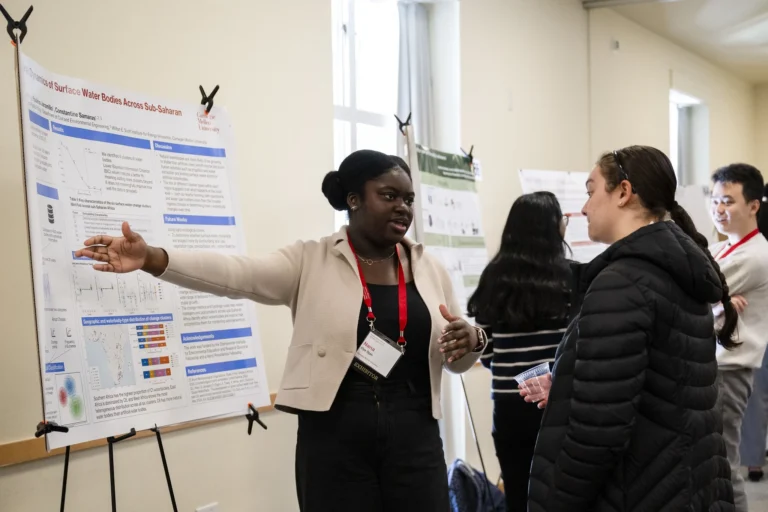
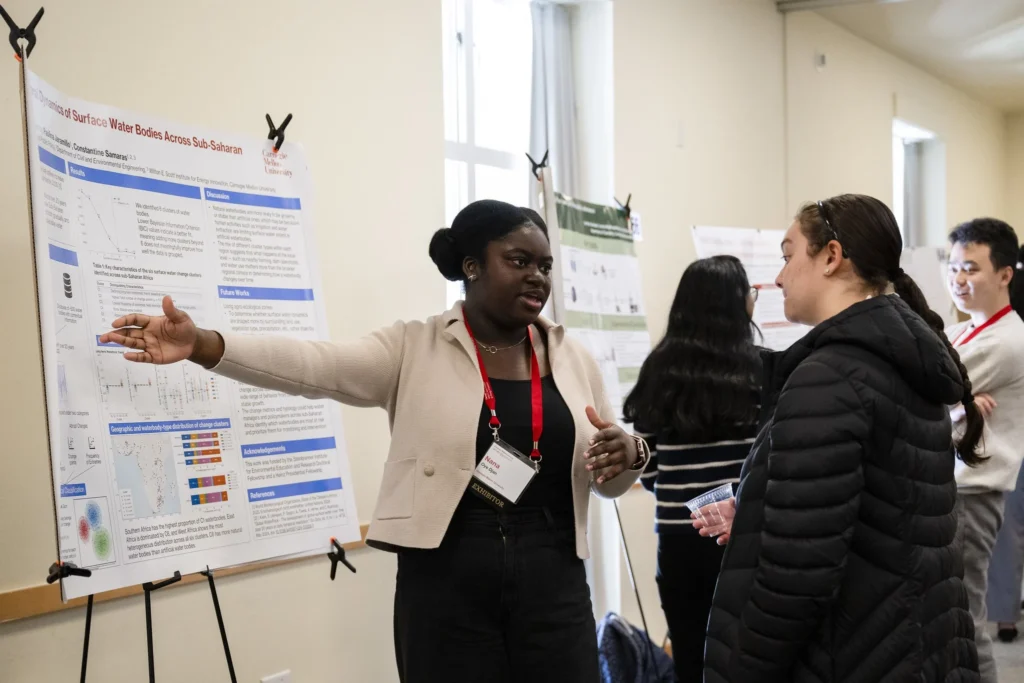
Her aim is to help establish what is changing and how much of that change can be attributed to climate change. In March 2026, her poster on how surface water bodies across sub-Saharan Africa are changing won one of two sustainability awards at Carnegie Mellon’s Student Energy and Sustainability Research Symposium.
That distinction matters. Observing a change in a body of water is not the same as understanding its cause. Her research seeks to move from documenting conditions toward evidence that can inform choices about climate mitigation, intervention, and adaptation. The intended contribution is to make the scientific basis for those decisions clearer.
The methods differ substantially from the biological experiments she encountered at Ashesi. So do the questions and the institutions involved. Yet there is a recognizable connection: both lines of work begin with environmental pressures affecting African communities and ask what investigation can add to the available responses. Her trajectory shows how an early research experience can open possibilities beyond the discipline in which it first occurs.
She has also continued to help build the communities in which such work happens. In 2025, Djan joined the Water Prediction Innovators Summer Institute as one of 23 student fellows.
The institute brings graduate researchers together with faculty and professionals to work on water prediction and flood forecasting. The following year, she helped coordinate the institute and co-edited its research report with Megan Vardaman. These were opportunities to contribute to research collaboration as well as to develop her own expertise.
For Djan, collaboration has become part of the work itself. At Ashesi, she helped bring a new scientific field into the classroom; in the water-science community, she has helped researchers bring their findings together. Her own questions now concern the freshwater on which African communities depend.
Answering them requires both the tools to understand environmental change and people able to connect that understanding with decisions about adaptation.