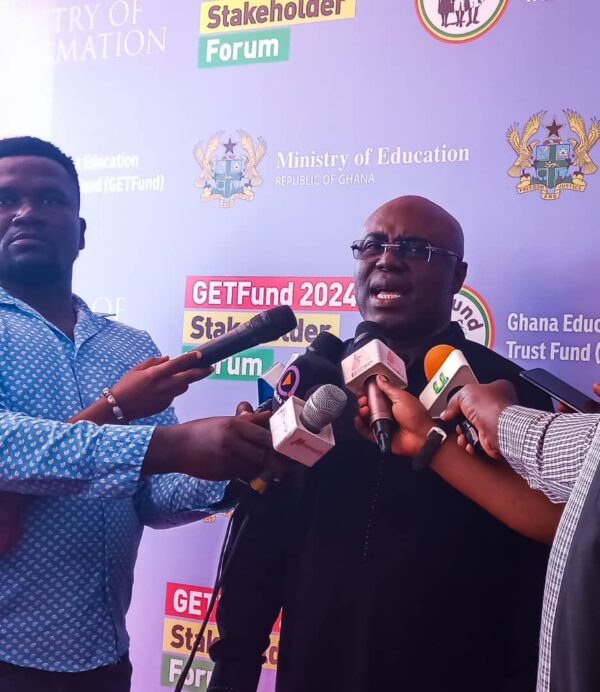
Dr Richard Ampofo Boadu
The Ghana Education Trust Fund (GETFund) has made significant strides in transforming education across the country through extensive development projects.
The achievements of the Ghana Education Trust Fund over the years were highlighted at a Stakeholder Forum on Tuesday (22 October), on the theme: Supporting the Delivery of Quality Education: The Impact of GeTfund on Contemporary Education.
Dr Richard Ampofo Boadu, Administrator for GETFund, stated that, as part of its commitment to fostering a globally competitive workforce, GETFund has expanded access to tertiary education through scholarships.
In the 2023/24 academic year, the fund awarded 5,026 local scholarships and 224 foreign scholarships to students pursuing higher education. These scholarships were aimed at reducing financial barriers, allowing students from diverse backgrounds to access quality education both in Ghana and abroad.
He underscored the importance of GETFund’s scholarship program playing a crucial role in empowering students to study in prestigious institutions worldwide.
Stating that, “This exposure equips them with advanced skills, which they bring back to contribute to national development in fields like healthcare, engineering, and technology.”
The foreign scholarships, in particular, enhance Ghana’s education system by fostering a globally oriented workforce.
He added that, GETFund’s focus on improving educational infrastructure includes the construction of science and technology laboratories, essential for STEM education.
These modern facilities support hands-on learning, equipping students with practical skills in a technology-driven world. Schools and universities that have benefited from these upgrades now offer students access to cutting-edge technology and resources.
According Dr Richard Ampofo, as part of the achievements of GETFund, the institution has overseen the completion of 1,823 legacy projects and 1,245 new projects which has significantly improved the infrastructure of schools and tertiary institutions, creating modern, well-equipped environments for learning.
“And when you look at the figures, the legacy projects from 2017 and the current projects, we see that the legacy projects are more than what the new ones.
“If you all remember, when the Free switches came on, they were all mixed together. So it went like that. We had to find a way to accommodate the students in there. So we had to refocus ourselves and we had to also complete the legacy projects.
“Because you cannot say that there is an increment in the system. So we had to build only new projects to absorb the students. So we had to do multiple things at the same time. So completion of legacy projects was targeted. The secondary education improvement projects were also continued,” he said.
He says the projects include the construction of classrooms, libraries, dormitories, ICT centers, and laboratories.
The new facilities have alleviated overcrowding, enabling students to thrive academically in more conducive learning spaces.
Moreover, the construction of ICT centers in rural schools has help bridge the gap of digital divide, ensuring that students from underserved communities have access to modern technology.
This has been a vital step in integrating technology into the learning process and ensuring that all students, regardless of their location, are equipped with digital skills essential for today’s global economy.
The impact of GETFund’s investments in education extends beyond infrastructure.
By offering scholarships and upgrading facilities in rural and underserved areas, GETFund ensures that students from all regions of Ghana benefit from quality education.
Reporting by Abigail Teye in Accra