Illegal mining on cocoa farms
Ghana’s fight against illegal mining, popularly known as galamsey, has reached a critical juncture. As the government explores ways to formalise eligible artisanal and small-scale miners, a fundamental principle must remain non-negotiable: no economic activity should be permitted to destroy the agricultural assets, livelihoods and ecosystems upon which the country’s long-term prosperity depends.
The Ghana Cocoa Board Act, 2026 (Act 1182), provides an important legal foundation for defending one of Ghana’s most valuable agricultural resources.
By according cocoa farms protected status and establishing safeguards against mining and other prohibited extractive activities, including a reported 500-metre restriction around protected farms, the law reinforces a principle that should guide national development: the pursuit of mineral wealth must not come at the expense of agricultural sustainability.
The challenge now is to translate that principle into effective enforcement.
Protecting more than cocoa trees
Cocoa is far more than an export commodity. It sustains hundreds of thousands of farming households, supports rural economies and contributes to Ghana’s international economic standing.
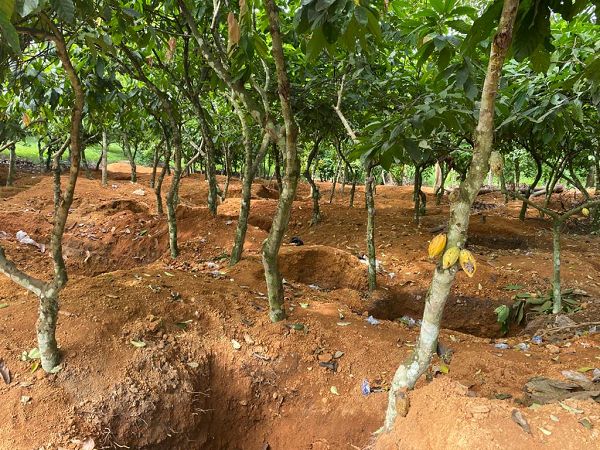
Behind every productive cocoa farm lies years of labour, investment and accumulated agricultural knowledge. When illegal mining destroys such a farm, the loss extends beyond uprooted trees. It can deprive families of their principal source of income, degrade productive soil, threaten water resources and undermine the economic prospects of future generations.
The damage may also extend beyond the immediate mining site. Excavation, erosion, altered drainage and potential contamination can affect neighbouring farms and communities.
For Ghana, therefore, protecting cocoa farms is not simply an agricultural responsibility. It is an economic, environmental and social imperative.

Act 1182 must mean what it says
The enactment of Act 1182 creates an opportunity to strengthen the protection of cocoa farms against destructive activities. Its effectiveness, however, will depend on the clarity of its implementation and the consistency with which the law is enforced.
The reported 500-metre restriction is particularly significant because the risks associated with mining are not always confined to the precise location of excavation. Activities close to cocoa farms can compromise their productivity and threaten surrounding ecosystems.
To make this protection effective, the relevant authorities must establish reliable farm maps, clearly identify protected areas and ensure that proposed mining sites are screened against applicable restrictions before authorisations are granted.
The Ghana Cocoa Board, mining regulators, environmental authorities, land administration institutions and local government must work together to prevent conflicting decisions and close enforcement gaps.
A protected farm must not exist only on paper. Its protection must be visible in the security of the farmer, the integrity of the land and the continued productivity of the crop.
Formalisation is not a licence to break the law
Recent public debate surrounding comments by Ghana Gold Board Chief Executive Officer Sammy Gyamfi has renewed attention to the government’s approach to unlicensed mining.
There is a legitimate case for formalising eligible artisanal miners. Proper licensing, registration, environmental standards and regulatory oversight can improve accountability, support livelihoods and help move mining into the lawful economy.
But formalisation must never be confused with permission to mine wherever an operator chooses.
An unlicensed operation does not become lawful simply because it is economically beneficial or located outside a forest reserve or water body. Its eligibility for formalisation must be assessed under the applicable legal framework, including restrictions governing protected cocoa farms.
A miner who qualifies for formalisation must still comply with every applicable law governing where mining may take place.
This distinction is essential. Formalisation should create a pathway towards lawful mining, not an avenue for circumventing environmental safeguards or statutory prohibitions.
Where mining is prohibited to protect cocoa farms, no administrative arrangement or economic justification should be used to override that restriction.
The objective is not to demonise miners or dismiss the economic pressures facing mining communities. It is to ensure that legitimate economic opportunities are pursued within the law and without transferring unacceptable costs to farmers and the wider public.
From legislation to enforcement
Three priorities should guide implementation.
First, with the already existing Cocoa Management System (CMS), Ghana can develop an authoritative, georeferenced register of protected cocoa farms to help regulators identify prohibited areas and verify compliance with the prescribed buffer.
Second, enforcement must be consistent and evidence-based. Those responsible for illegal mining should be investigated and held accountable in accordance with the law, regardless of their political connections, financial influence or position in society.
Third, COCOBOD can further strengthen the economic viability of cocoa farming through improved access to agricultural inputs, extension services, farm rehabilitation and effective support for farmers. Protecting cocoa farms requires both enforcement against unlawful destruction and sustained investment in the livelihoods that make farming worthwhile.
These measures should complement a transparent formalisation programme that directs eligible miners towards lawful sites and requires compliance with environmental and licensing obligations.
A national interest beyond partisan politics
The protection of cocoa farms should not become another casualty of political disagreement.
The government’s anti-galamsey policy must be assessed against clear standards: compliance with the law, effective environmental protection and measurable results for affected communities.
Ghana must demonstrate that its commitment to responsible mining is compatible with its responsibility to protect agriculture. It must also assure international cocoa buyers, processors and development partners that the country is serious about safeguarding the land and communities that sustain its cocoa industry.
The choice is not between gold and cocoa. It is between a development model that respects the limits of lawful economic activity and one that allows immediate commercial gains to undermine long-term national prosperity.
Act 1182 provides an important foundation. The real test lies in its implementation.
Ghana’s cocoa farms represent generations of investment and a vital source of rural livelihoods. Their destruction in the pursuit of gold would impose costs far greater than the value of the minerals recovered.
The gold beneath Ghana’s soil may be valuable, but it must never become an excuse to destroy the cocoa farms that help sustain the nation.