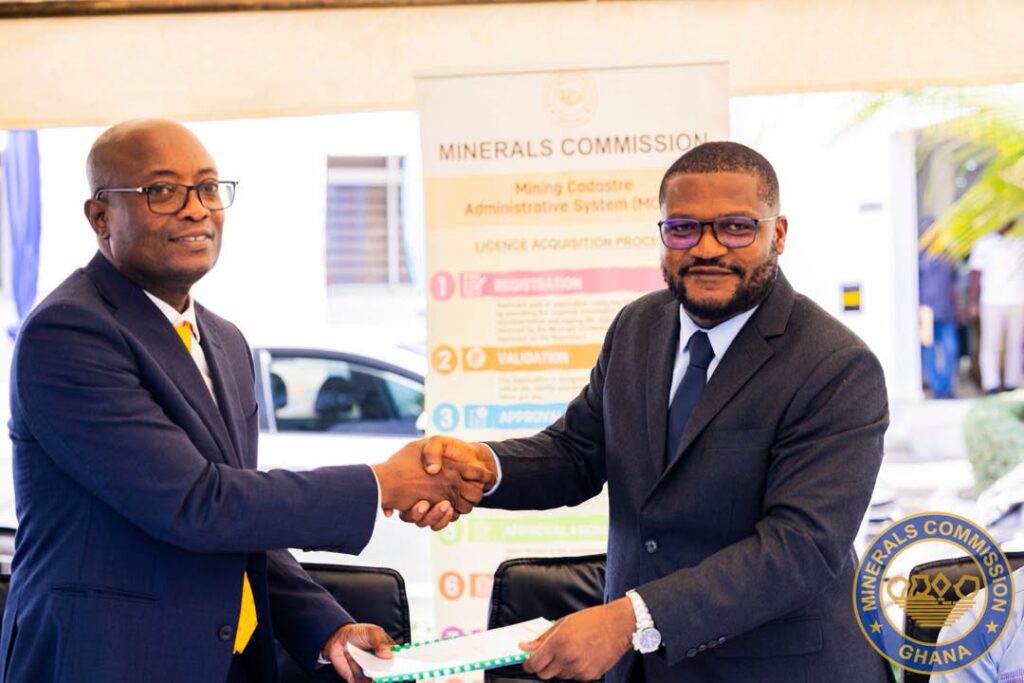
Carl Selasi Asem(left) and Isaac Tandoh
The Minerals Commission and CalBank have signed a Memorandum of Understanding (MoU) aimed at strengthening indigenous participation and expanding access to financing across Ghana’s mining value chain.
The agreement, signed on Tuesday, November 17, 2026, at the forecourt of the Minerals Commission’s Head Office in Accra, is intended to support Ghanaian contractors, suppliers, small-scale miners and other service providers operating in the mining industry.
Under the partnership, CalBank has committed GH¢1 billion in financing support to eligible Ghanaian businesses. The funding will cover working capital, contract financing, invoice discounting, equipment acquisition and other strategic business needs.
Speaking at the ceremony, CalBank Managing Director, Carl Selasi Asem, said many indigenous businesses had the technical expertise and commercial opportunities to compete for major contracts in the mining industry but continued to face financial constraints that limited their capacity to undertake larger projects.

He explained that the partnership was intended to bridge these financing gaps, enabling Ghanaian businesses to compete more effectively and expand their operations.
Mr Asem further indicated that the GH¢1 billion commitment represented the beginning of the bank’s efforts to support indigenous businesses in the sector.
Welcoming the initiative, Chief Executive Officer of the Minerals Commission, Isaac Andrews Tandoh, commended CalBank for taking practical steps to address one of the major challenges confronting local businesses in the mining industry.

He said that, as the regulator of Ghana’s mining sector, the Commission was committed not only to ensuring responsible mineral resource development but also to creating an enabling environment in which Ghanaian businesses could grow, compete and benefit meaningfully from the country’s mineral wealth.
Mr Tandoh noted that improving access to finance for indigenous contractors and service providers was essential to strengthening local content, creating employment opportunities and improving livelihoods in mining communities.
He described the partnership as an important step towards translating local content aspirations into tangible economic opportunities for Ghanaian enterprises.

He stressed that initiatives that directly improve the lives and businesses of Ghanaians were the kind of progress the mining industry should continue to promote.
The partnership reinforces the Minerals Commission’s commitment to building a more inclusive, competitive and sustainable mining industry in which Ghanaian businesses are empowered to play a greater role in the country’s mineral value chain