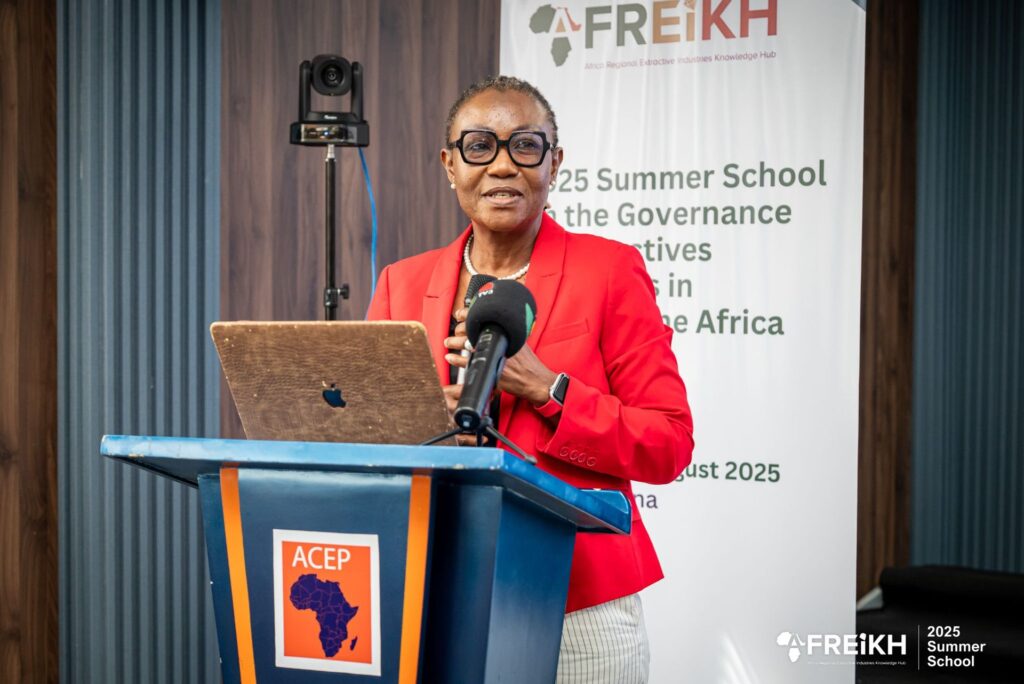
Nafi Quarshie
The Natural Resource Governance Institute (NRGI), in partnership with the Africa Centre for Energy Policy (ACEP), has opened the 2025 edition of the Anglophone Africa Summer School on Extractive Industries Governance with a strong call for Africa to take charge of its role in the global energy transition.
Delivering the welcome address, Nafi Quarshie, NRGI’s Africa Director, warned that the global shift toward clean energy is reshaping geopolitics and development, creating both risks and opportunities for Africa’s resource-rich nations.
“Critical minerals are fast becoming the new oil,” she said. “They are attracting global powers who see Africa as a source of supply, but not always as a partner in shaping the terms. We must not allow the past to repeat itself.”
Quarshie stressed that the continent must decide whether it will be a “rule-taker or a rule-maker” in the new energy order, pointing to the paradox where resource wealth has historically led to poverty, environmental damage, and unfulfilled promises.
She called for greater transparency, accountability, and citizen participation in managing the revenues from transition minerals such as cobalt, lithium, bauxite, and copper.“The energy transition is not only about technology, it is about power — who holds it, and for what purpose,” she told participants.

The Summer School, which runs for two weeks, has brought together stakeholders from civil society, academia, media, and government to interrogate Africa’s extractive governance frameworks and explore ways to ensure that mineral wealth translates into jobs, infrastructure, education, and public services.
Quarshie also emphasized the need to safeguard the environment while empowering women and youth as decision-makers in the governance of natural resources. She urged participants to approach the programme with “courage, curiosity, and a fierce sense of purpose,” noting that their knowledge and collaboration would help build a “more just, equitable, and sustainable future.”
The 2025 Summer School marks another milestone in efforts to strengthen governance capacity across Anglophone Africa, as demand for transition minerals continues to intensify globally.