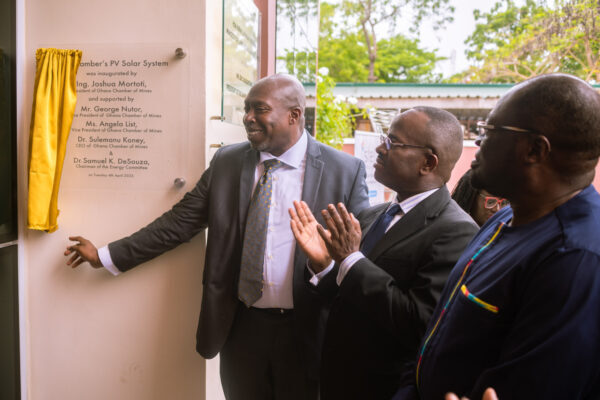
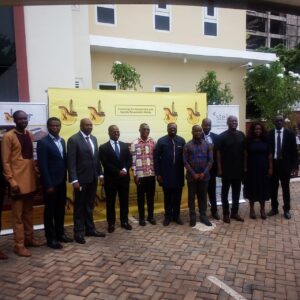
Sulemanu Koney(Middle)
The Chief Executive Officer of the Ghana Chamber of Mines Sulemanu Koney has advised government to consider removing taxes on the payment for solar projects in the country.
Koney believes the payment of taxes on solar projects will defeat governments agenda of encouraging the use of renewable energy as Ghana transitions from reliance on fossil-based energy to cleaner alternatives.
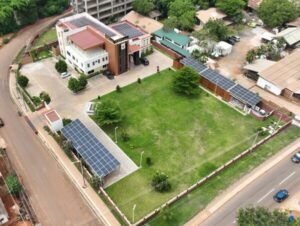
Speaking at the inauguration of an ultra-modern and intelligent grid-tied solar photovoltaic (PV) system at the secretariat of the Chamber on Tuesday (4 April) in Accra, Koney called on government to expedite work on the net metering framework.
“Ladies and gentlemen, you may be aware that the Government of Ghana is fully aligned on the global initiative to transition to clean and sustainable energy. However, the ecosystem that is required to encourage households and firms to invest in clean energy is still in an inchoate stage.”
“While the government has exempted imported solar panels from VAT and other levies, the payments for a completed project are still subject to these statutory taxes and levies. Further, the absence of a net metering system implies that a consumer would be subsidizing the operational cost of ECG anytime the solar plant feeds its excess generation beyond its demand into the national grid. We implore the government, particularly, the Public Utility Regulatory Commission (PURC), to expedite its work on the net metering framework.”
“It is instructive to note that nearly 11 per of the contract cost represents statutory taxes and levies, which is a disincentive to the government’s energy transition agenda,” Koney said.
About PV system
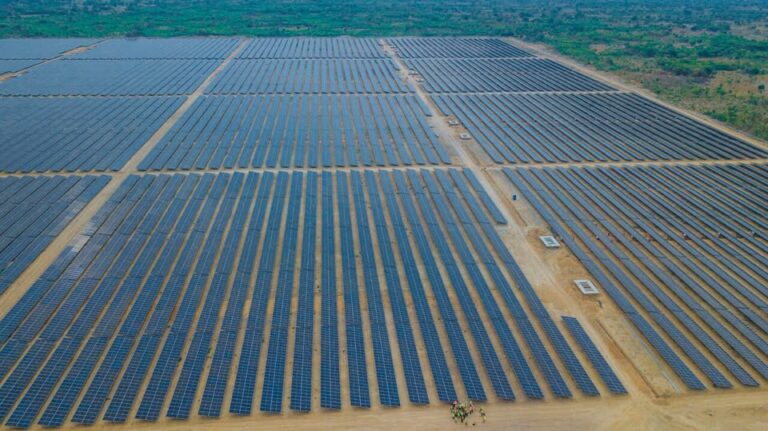
The solar system that was designed to meet the Secretariat’s electricity requirements has an installed capacity of 84kWp and was constructed at a total cost of US$ 122,316.35
At peak conditions, the system has the capacity to generate 111,000 kWh, and its use has reduced the Chamber’s consumption of electricity from the national grid by nearly 75 per cent.
The payback period for the project is estimated to be under eight (8) years based on a set of assumptions on the exchange rate and electricity tariff. The infrastructure has a warranty period of 10 years and a performance period of twenty-five (25) years.