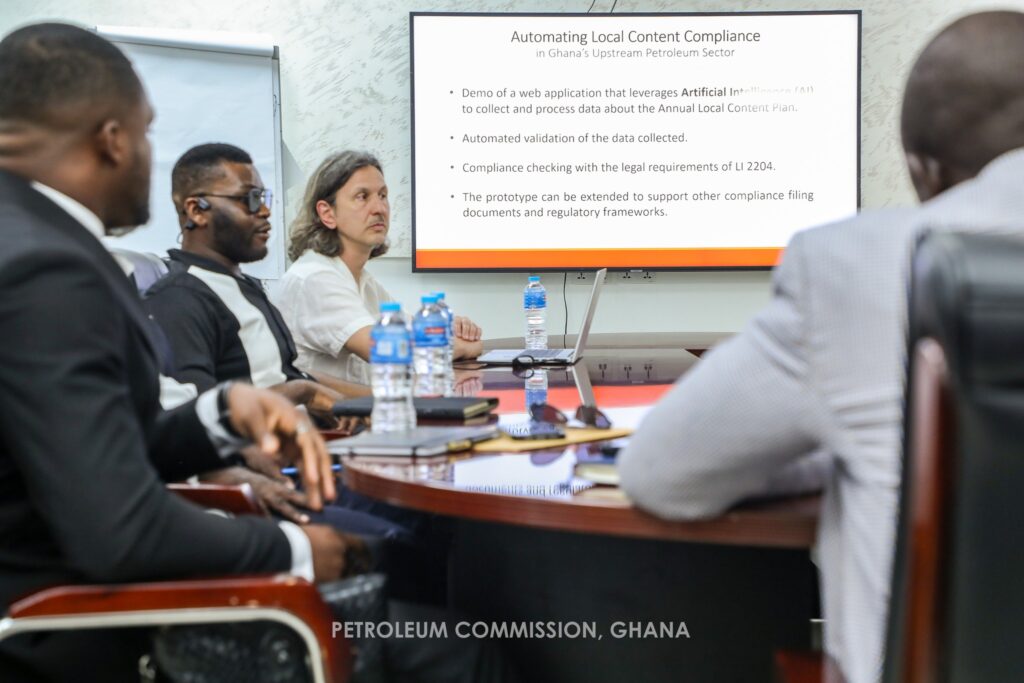
In a remarkable demonstration of innovation and resilience, the Petroleum Commission of Ghana recently hosted Joseph Anim, a visually impaired PhD candidate from Swansea University in the United Kingdom, who presented an artificial intelligence (AI)-powered prototype aimed at transforming local content compliance in Ghana’s petroleum sector.
Mr. Anim’s groundbreaking project leverages AI to automate and streamline the monitoring and verification of compliance with Ghana’s Local Content Regulations—an increasingly complex task in an industry where companies produce thousands of pages of documentation annually.
His work is the product of years of rigorous research at the intersection of technology and regulatory compliance, conducted with input and guidance from the Commission’s Economics & Local Content Directorate.

According to the Petroleum Commission, the prototype represents a significant step forward in the application of smart technologies to regulatory governance.
With Ghana intensifying efforts to ensure that its oil and gas sector delivers tangible benefits to local communities and businesses, tools like Mr. Anim’s have the potential to greatly enhance transparency, efficiency, and enforcement.
“This achievement is more than a technological milestone—it is a testament to the power of inclusive innovation,” the Commission stated. “Joseph Anim’s work exemplifies how diverse perspectives can help shape solutions to some of the most complex challenges in our industry.”

As Ghana deepens its local content development agenda, the AI model could offer a scalable solution not only for the country but for other resource-rich nations on the continent seeking to strengthen regulatory oversight through digital transformation.
The Petroleum Commission lauded Anim’s perseverance and ingenuity, reaffirming its commitment to supporting research and innovation that align with