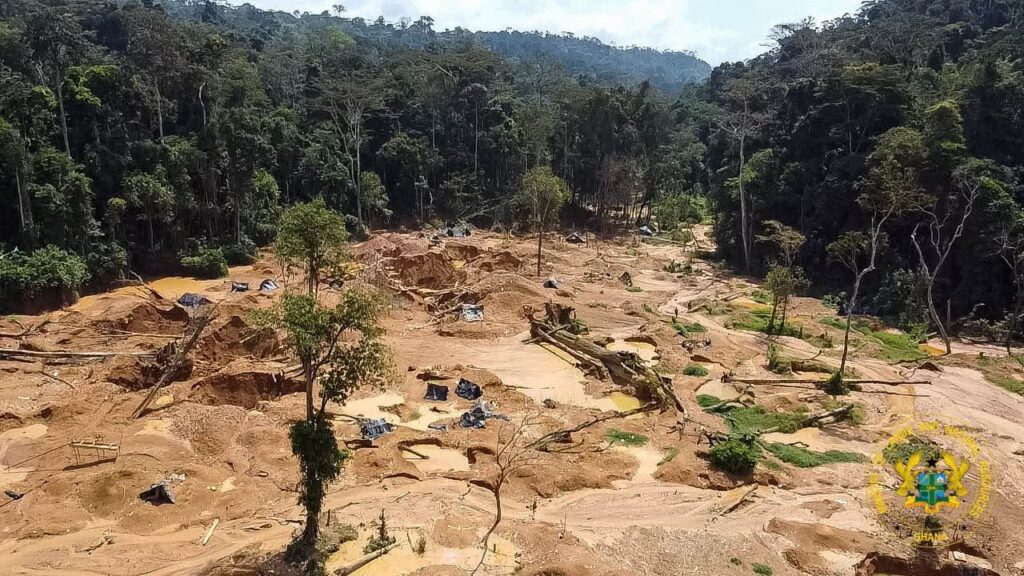
Some portions of Atewa Forest destroyed by illegal miners
The destruction of Ghana’s forest reserves is threatening the country’s water sources, with the Atewa Forest among the critical ecosystems whose protection is necessary to safeguard water supplies for surrounding communities.
Hannah Koranteng, Associate Executive Director of Wacam, warned that continued forest loss through extractive activities could worsen water insecurity and increase dependence on alternative water sources.
She said forests serve as important sources of water for communities, cautioning that their destruction could have consequences beyond biodiversity loss.
Speaking at the 5th Allison Mary Howell Symposium on Church and Environment in Accra on Tuesday (November 10), she cited the Atewa Forest and Bonsa Forest as examples of forest ecosystems whose protection is important for the country’s water resources.

She explained that the Bonsa River, for instance, originates in a forest area, stressing that the loss of such ecosystems also puts water sources at risk.
Koranteng expressed concern about the scale of forest destruction across the country, citing data indicating that 13 forest reserves had been lost to extractive activities in the Ashanti Region.
She also said 23 forest reserves had been lost across the Western and Western North regions, while the Upper East Region had lost three.
She warned that the continued destruction of forest reserves could undermine the natural systems that sustain communities and their access to water.
Koranteng also raised concerns about the safety of bottled water, arguing that consumers could be exposed to heavy metals without adequate information about the chemical composition of the water they drink.
She identified lead, cadmium, arsenic and manganese among the heavy metals of concern and questioned the adequacy of testing and disclosure of heavy metal levels in locally produced bottled water.
According to her, consumers may assume bottled water is safe without having access to sufficient scientific information about its heavy metal content.
She called for greater responsibility in addressing the environmental challenges, particularly the destruction of forests and the potential consequences for water security and public health.
The symposium, held under the theme African Christian Worship and Earthkeeping, was hosted by A Rocha Ghana in collaboration with the Akrofi-Christaller Institute of Theology, Mission and Culture and the Global Theological Seminary.
The gathering provided a platform for discussions on the relationship between faith, theology and environmental protection, highlighting the role of religious institutions in promoting responsible stewardship of the environment.
watch the symposium in the attached video clip: