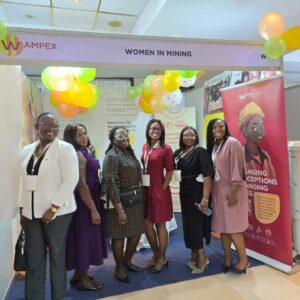
At the sidelines of WAMPEX 2025, Georgette Barnes Sakyi-Addo, President of Women in Mining (WIM) Ghana, delivered a strong call for policy-driven action to ensure greater inclusion of women in Ghana’s mining industry. Speaking exclusively to Ghextractives.com, she emphasized that despite progress over the past decade, systemic change will require deliberate and enforceable regulations.
“For me, it’s an economic empowerment issue,” she said. “It’s about women—especially young girls in mining communities—gaining the education and skills they need to participate in an industry that extracts directly from their environment.”
Barnes Sakyi-Addo acknowledged that awareness around women’s involvement in mining has grown significantly, but without mandatory policy interventions, change will remain slow and uneven. “Nobody is under any real obligation to employ females,” she noted. “That’s why we need regulation—otherwise we’ll keep defaulting to the norm where mining is seen as a man’s world.”
She called for a 30% female participation quota across the mining workforce. Women currently make up only about 11%, a figure she finds unacceptable, especially considering that women represent just over 50% of Ghana’s population. “Girls are going to school. They are educated. And yet, they aren’t being employed at scale. That’s a policy failure,” she said.
She highlighted the ongoing technological transformation of mining—where automation and simulators are becoming more prevalent—as a unique opportunity to close the gender gap. “The macho face of mining is changing. You now see women driving haul trucks, training with simulators, and handling technical roles. But companies must design their operations to accommodate women meaningfully.”
Reflecting on her decade-long journey with WIM Ghana, Barnes Sakyi-Addo pointed to milestones such as influencing gender inclusion in the Local Content Act and engaging directly with the Minerals Commission, which once had no gender desk. “The high point for me is industry acceptance and recognition of our work,” she shared. “We pushed for inclusion, and now every agency in the minerals sector ensures women are at the table.”
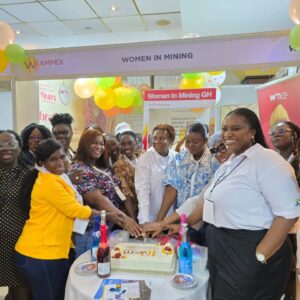
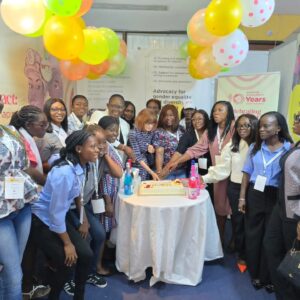
As part of their presence at WAMPEX 2025, WIM Ghana also marked its 10th anniversary with a symbolic cake-cutting ceremony, celebrating a decade of advocacy, industry engagement, and progress in promoting gender equity in Ghana’s mining sector.
To overcome these challenges, she urged continuous community engagement, inclusive policy design, and a national commitment to gender equity in extractives.“If we’re serious about empowerment, then the policies must reflect it. The opportunities are there—now we need the will to open the doors.”