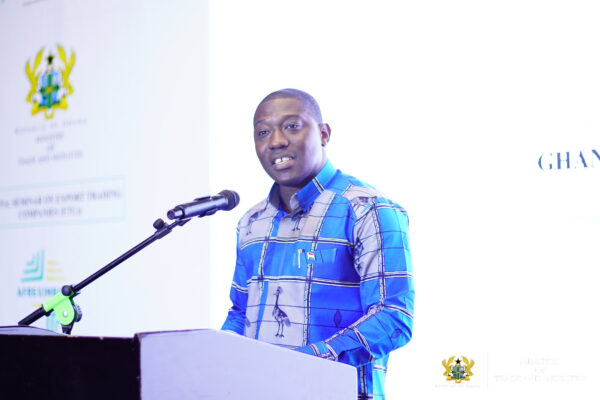
Herbert Krapa
Actual trading is starting between eight African countries under the Africa Continental Free Trade, Area (AfCFTA), deputy trade minister Herbert Krapa has said.
The countries are Cameroon, Egypt, Kenya, Mauritius, Rwanda, Tanzania, Tunisia and Ghana.
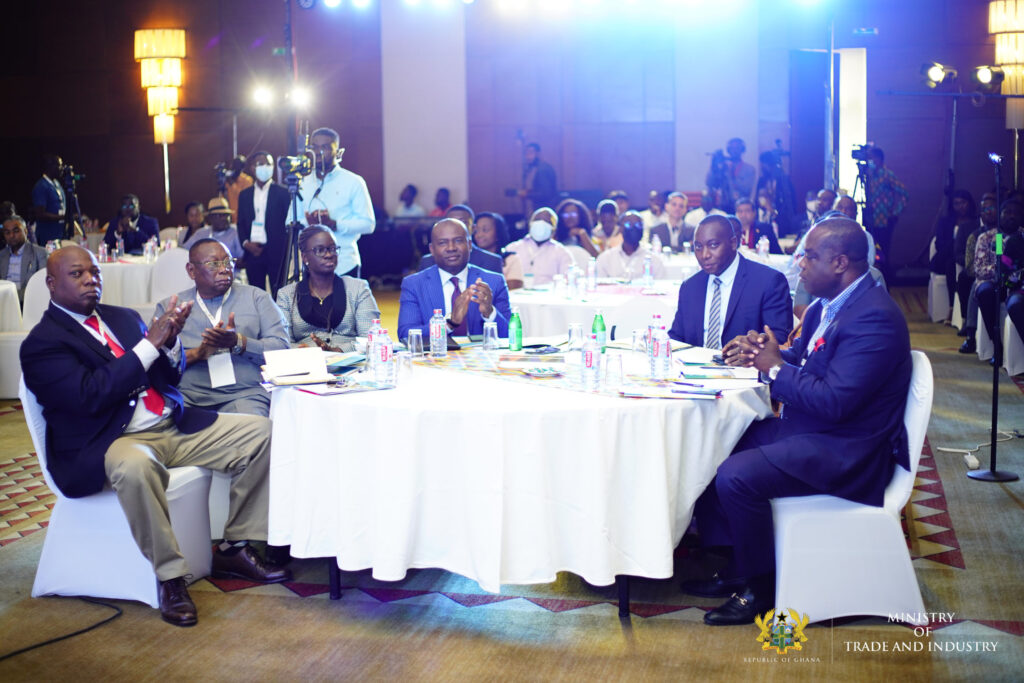
Speaking at the AfrixemBank Export Trading Companies seminar in Accra on Monday (22 August) Krapa said the AfCFTA secretariat deserves commendation for its work spo far.
“Our industrial revolution with capacity for self-reliance is today beyond debate, and our ability to do so, should be the same by now. We know the Africa we want when we see it and we must work together to see it.
“The AfCFTA Secretariat and its young dynamic Secretary General deserve to be congratulated for leading what I believe is a successful implementation in the making.”
“The Secretariat has also launched the AfCFTA Initiative on Guided Trade to simply translate all the progress on paper into action. Actual trading is starting between Cameroon, Egypt, Kenya, Mauritius, Rwanda, Tanzania, Tunisia and Ghana,” Krapa said.
He said only about 1500 companies out of 3000 export companies in Ghana are currently engaging in significant export.
“Only half of 3000 export companies in Ghana for instance engage in significant trading, with the other half, finding respite in sporadic exports annually. This has to change! Why must 70% of our total non-traditional exports revenues be generated by only a few companies?”
Our Export Expansion Programme is expected to assist an initial 200 private firms in enhancing their productive capacity for export in a competitive African market. Even better news is that majority of the identified companies are participating in this seminar.
Below is the full statement:
SPEECH DELIVERED BY HON. HERBERT KRAPA, DEPUTY MINISTER OF TRADE AND INDUSTRY, AT THE AFREXIMBANK EXPORT TRADING COMPANIES SEMINAR SERIES ON 22nd AUGUST, 2022 AT THE MOVENPICK AMBASSADOR HOTEL, ACCRA
REPRESENTATIVES OF AFREXIMBANK, LED BY DR ZANAMWE AND MR ERIC MONCHU;
REPRESENTATIVE OF THE AFRICAN DEVELOPMENT BANK;
CHIEF EXECUTIVE OFFICERS OF GIPC, GNPA, GEPA, GEXIM, GFZA; MEMBERS OF THE DIPLOMATIC CORPS;
MEMBERS OF THE EXPORTING COMMUNITY;
CAPTAINS OF INDUSTRY;
FRIENDS FROM THE MEDIA;
LADIES AND GENTLEMEN…
On behalf of my Minister, the Government and People of Ghana, I welcome all of you to Accra, the historic capital city that famously inspired a continent’s independence movement, and now befittingly chosen by our Heads of State as Africa’s commercial capital and headquarters for economic integration. Welcome back home I should say.
Africa’s economic integration having long lacked the non-negotiable ingredient of commitment for success, is today seeing the light of day, all thanks to a generation of leaders of an era so determined to see our story change for good.
In real tangible terms, a significant amount of that progress is deservedly to Afrexim bank’s credit. The bank’s swift and ever so strong partnership with the AfCFTA Secretariat has provided the impetus for the implementation of an agreement on which the hopes of millions across the continent rests, and we are now able to say without equivocation at all, that Africa’s Agenda 2063, thankfully is no more cliché.
Our industrial revolution with capacity for self-reliance is today beyond debate, and our ability to do so, should be the same by now. We know the Africa we want when we see it and we must work together to see it.
54 African countries have signed the AfCFTA Agreement;
46 have submitted their tariff offers, including 4 Customs Unions;
29 tariff offers have been technically verified for trading;
87.7% of tariff lines have been agreed upon under the Rules of Origin negotiations;
And Phase two negotiations on Investment, Intellectual Property Rights, Competition Policy, Women and Youth in Trade and Digital Trade are ongoing.
The AfCFTA Secretariat and its young dynamic Secretary General deserve to be congratulated for leading what I believe is a successful implementation in the making.
The Secretariat has also launched the AfCFTA Initiative on Guided Trade to simply translate all the progress on paper into action. Actual trading is starting between Cameroon, Egypt, Kenya, Mauritius, Rwanda, Tanzania, Tunisia and Ghana. In the coming weeks the dream of our forebears will be off the ground, and historic as the moment may be, its only beneficiaries will be those Member States who have done the ground work: policy, finance, institutional framework, productive capacity and infrastructure.
Setting up Export Trading Companies across Africa could not be at a better time. AfCFTA is about exports and we must commend the Bank for initiating a strategy to facilitate the setting up of these Export Trading Companies. After the tariffs have been agreed and negotiations concluded, we will be measured perhaps solely by the volume and value of trading among ourselves.
Trading goods and services from Harare in Bamako or Kigali, or exporting processed cocoa from Accra to the entire northern African region should no longer be a nightmare if we make the appropriate investments into ETCs.
ETCs will help us to leave no one behind in the regional value chain: SMEs, young entrepreneurs, startups, light manufacturers and big industry. By providing export and import services, warehousing, transportation, finance, insurance, risk management and market intelligence, they are the fulcrum around which the free trade area will thrive.
Only half of 3000 export companies in Ghana for instance engage in significant trading, with the other half, finding respite in sporadic exports annually. This has to change! Why must 70% of our total non-traditional exports revenues be generated by only a few companies?
Our Export Expansion Programme is expected to assist an initial 200 private firms in enhancing their productive capacity for export in a competitive African market. Even better news is that majority of the identified companies are participating in this seminar.
We are also implementing a National Export Development Strategy with an ambitious target of increasing non-traditional export revenues to 25billion United States Dollars by 2029. We have identified 17 priority products for export under this Strategy, ranging from automobiles and vehicles, industrial salt and starch, sugar and processed oil seeds, to aluminium, iron and steel and pharmaceutical products.
Two months ago, Ghana Export Promotion Authority announced a 3.3 billion United States Dollars increase in non-traditional export earnings for 2021, and I look forward to tracking the further astronomical increase in these revenues after the setting up of ETCs in Ghana.
Three weeks ago, we launched the National Action Plan and Policy Framework for Boosting Ghana’s Trade with Africa to expedite meaningful implementation. The Plan will support the establishment of a Special Purpose Vehicle to improve the production and marketing of goods and services under AfCFTA, and provide alternative financing and intermediation between exporters and banks.
It will also strengthen Export Finance Institutions to deliver tailormade services to support export under AfCFTA while facilitating the establishment of a national version of the African Customer Due Diligence (MANSA) Repository Platform to register exporters. The number of SME trade finance applications rejected by banks increased sadly from 20% in 2013 to 40% in 2019, and weare determined to do everything we can to reverse this unacceptable cycle.
The Action Plan is also expected to support the establishment of Export Trade Houses across Africa, and the timing of this Seminar here in Accra, what I understand is the third in the series, after South Africa and Kenya, is indeed significant.
The success of the African Continental Free Trade Area is of particular importance to our government in many ways. His Excellency President Akufo-Addo sees the implementation, and the participation of Ghanaian businesses as an essential element of government’s vision of creating shared prosperity, advancing economic competitiveness and strengthening our institutions. Government’s pursuit of an aggressive industrial transformation agenda in the last six years has been at the core of this vision.
The world economy today is on its knees. People everywhere are feeling the harsh effect of COVID, conflict and climate, and we in Africa, find ourselves on the wrong side of a catastrophe we had nothing to do with. Building self-reliant economies with the capacity to finance our development agenda, is as inevitable today as it should have always been.
We are home to 65% of the world’s remaining arable land and 40% of the world’s mineral reserves, yet our share of global trade remains at 3%. We cannot achieve inclusive economic growth without industrialisation, and we must take advantage of initiatives such as this, to build partnerships among our ranks for effective trading.
I urge all of us… government institutions, exporters, financing firms, manufacturers, SMEs and everyone else in the export ecosystem, to take very seriously the lessons of this Seminar, and it should energise us to set up Ghanaian owned or partnered Export Trading Companies both domestically and across Africa.
Africa’s industrial revolution must be realised at all cost in our lifetimes for posterity, and if there were ever an opportunity – one with the potential to unleash the sleeping talent of the African entrepreneur – with the ability to reduce significantly Africa’s dependence on everyone else for everything good – and which has the answer to empower our women and youth once and for all – the African Continental Free Trade Area is.
It will stimulate value addition to our begging and abundant natural resources, create jobs, build infrastructure, develop knowledge and skills and ultimately rewrite the stories of millions who live in extreme poverty across our continent, and today’s full day’s work, I believe takes us closer to that dream.
Once again, on behalf of the government and people of Ghana, I welcome you all to Accra and thank Afrexim Bank for facilitating this Seminar.
Thank you!!!
Fred Dzakpata