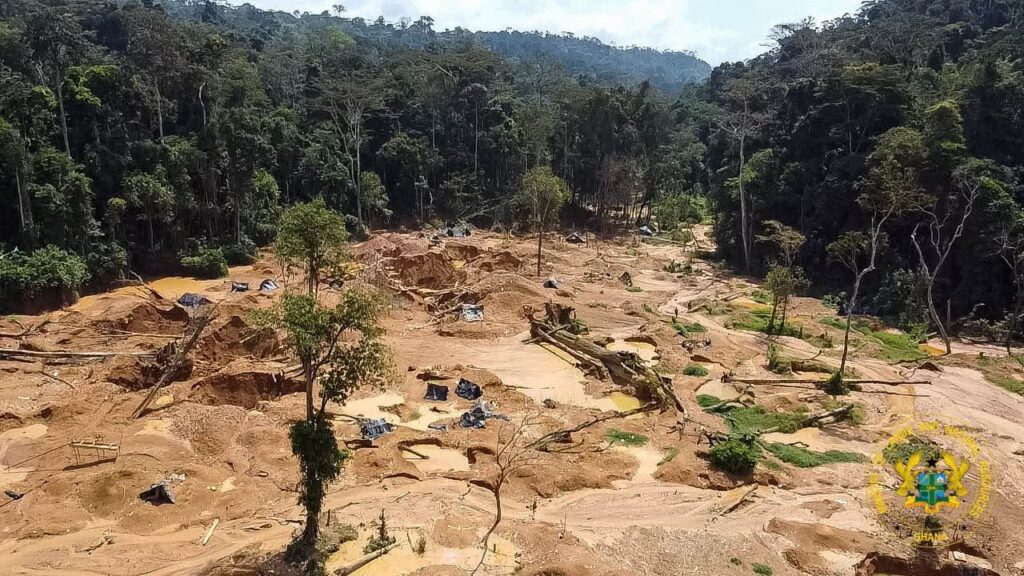
Some portions of Atewa Forest destroyed by illegal miners
The Concerned Citizens of Atewa Landscape (CCAL) has called on the government to maintain a continuous military presence in and around the Atewa Forest Reserve to prevent illegal miners from returning following the commencement of Operation Green Shield.
The group commended the Minister of Lands and Natural Resources, the ministry and the National Anti-Illegal Mining Operations Secretariat (NAIMOS) for implementing the operation, describing it as an important intervention to address illegal mining in the forest.
However, it said the success of the operation should be measured not only by the removal of illegal miners but also by the permanent protection and ecological restoration of degraded areas.

In a statement, CCAL recommended the establishment of security camps at strategic locations within and around the reserve, supported by 24-hour surveillance involving the military, Forestry Commission guards and other relevant security agencies.
It also called for regular patrols, monitoring of access routes and rapid-response arrangements to prevent illegal miners from re-entering the forest.
According to the group, withdrawing security personnel immediately after the operation could create opportunities for illegal miners to return and resume their activities.
Beyond security, CCAL called on the Ministry of Lands and Natural Resources to work with the Forestry Commission, the Environmental Protection Authority and other relevant institutions to develop and implement a comprehensive reclamation and ecological restoration programme.
It said the programme should include an assessment and mapping of all degraded portions of the forest, as well as the restoration of destroyed vegetation through reforestation and the planting of indigenous tree species.
The group further renewed its call for the government to expedite processes to upgrade the Atewa Forest Reserve to National Park status, arguing that this would strengthen its long-term conservation framework, protect biodiversity and secure water resources relied on by surrounding communities.
CCAL said the real success of Operation Green Shield would be determined by the permanent recovery and protection of the forest rather than the temporary absence of illegal miners.
The group also expressed its readiness to collaborate with government, traditional authorities, civil society organisations, local communities and other stakeholders to support lasting protection of the forest.
Established as a National Forest Reserve in 1926, Atewa was designated a Special Biological Protection Area in 1994 and a Hill Sanctuary in 1995. In 1999, it was listed among Ghana’s 30 Globally Significant Biodiversity Areas (GSBAs).
The forest is the source of three major rivers—the Ayensu, Densu and Birim—which provide water to an estimated five million Ghanaians, making Atewa a critical water resource for the region.
However, the forest has faced persistent threats, particularly illegal chainsaw logging since the 1990s. The situation has worsened over the years, prompting the deployment of security personnel to help protect the reserve.
The growing degradation has raised concerns among residents and environmental advocates about the long-term impact on livelihoods, biodiversity and water security.
# Make a Atewa a National Park
# Make a Atewa a National Park
# Make a Atewa a National Park