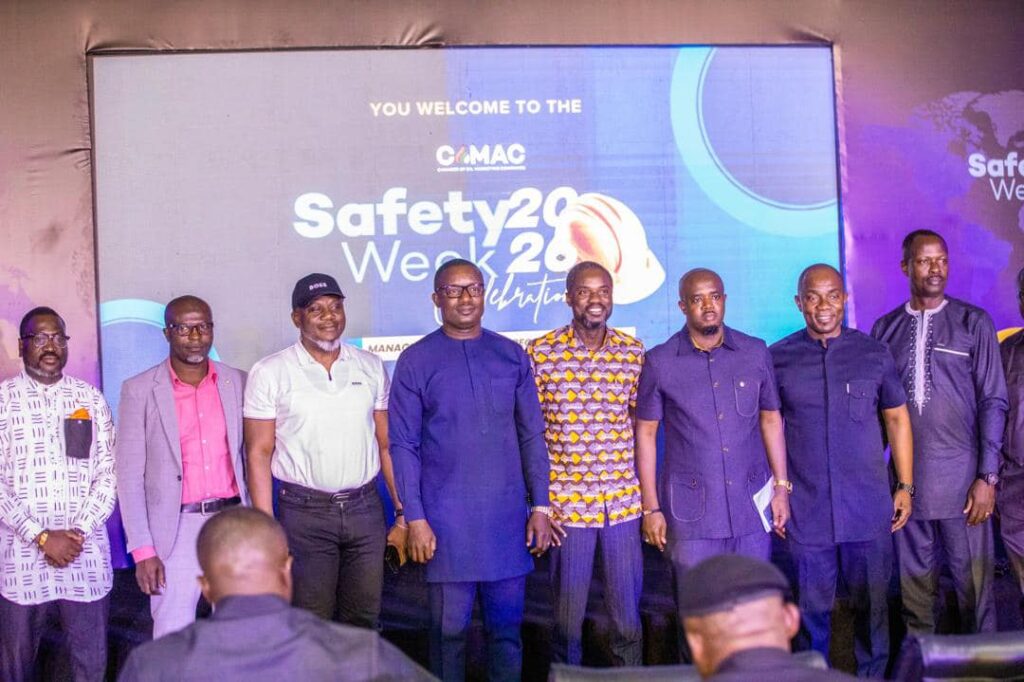
Dr Riverson Oppong, COMAC CEO (5TH from left)
Ghana’s petroleum downstream sector recorded a 25 percent increase in fuel exports in 2025, driven by rising demand from neighbouring West African countries, according to the Chief Executive Officer of the Chamber of Oil Marketing Companies (COMAC), Dr. Riverson Oppong.
Speaking at the opening of COMAC Safety Week 2026 in Accra on Tuesday, April 7, Dr. Oppong said Ghana exported about 1 billion litres of petroleum products to countries including Burkina Faso and Mali during the period under review.
He said the growth reflects Ghana’s strengthening role as a regional hub for petroleum supply, with increasing commercial opportunities emerging across the sub-region.
“For me, as a businessman and an economist, this tells us that there is business opportunity in this direction,” he noted, urging policymakers and regulators to strategically position Ghana as a reliable fuel supply centre for West Africa.
Dr. Oppong called on the Ministry of Energy and the National Petroleum Authority (NPA) to assess how Ghana can sustainably expand its regional supply role, while ensuring domestic fuel availability and price stability are not compromised.
Beyond exports, the downstream sector also recorded broader growth, with overall product supply and demand increasing by 15 percent in 2025. Total fuel imports stood at 8.7 billion litres, while domestic consumption reached 7.45 billion litres.
Despite the gains, he cautioned that Ghana remains heavily dependent on imported fuel—about 94 percent—highlighting the need to strengthen local refining capacity to reduce exposure to global supply shocks.
He warned that geopolitical tensions in key supply corridors could disrupt fuel availability, potentially leading to shortages if mitigation measures are not strengthened.
“If such disruptions were to occur in key supply corridors, the country could face severe shortages,” he cautioned.
The COMAC Safety Week, held under the theme “Managing Risk Before It Becomes an Incident,” brought together stakeholders in Ghana’s petroleum downstream sector to discuss safety, regulation, and industry best practices.
Dr. Oppong said beyond safety discussions, industry data trends such as rising exports should inform long-term policy and investment decisions in the sector.
He added that further discussions on regional fuel trade, import dependence, and infrastructure development are expected to feature at the upcoming Ghana International Petroleum Conference later this year.