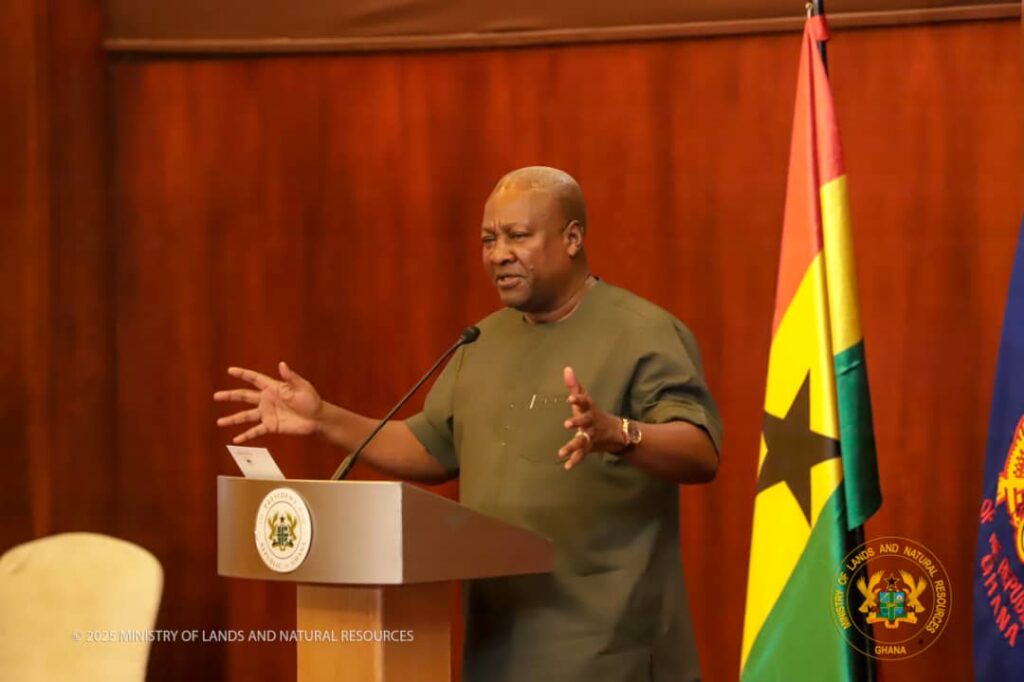
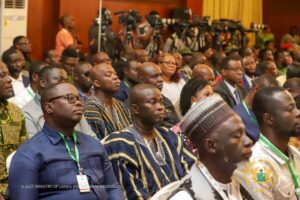
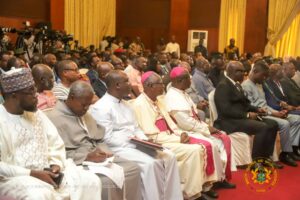
President John Dramani Mahama has convened a high-level dialogue at the Jubilee House, bringing together key Civil Society Organisations (CSOs), faith-based leaders, professional bodies, and mining associations to develop practical, lasting solutions to Ghana’s persistent illegal mining (galamsey) menace.
The meeting underscored the government’s renewed determination to combat galamsey, which has ravaged farmlands, polluted major rivers, and threatened livelihoods across the country.
Taking centre stage at the engagement, the Minister for Lands and Natural Resources, Emmanuel Armah-Kofi Buah , delivered an in-depth presentation on the current state of the illegal mining crisis and outlined government’s comprehensive plan to tackle it.
He noted that at the start of the year, Ghana reached a critical juncture in the fight against illegal mining — a challenge that has tested not only the nation’s environmental resilience but also its governance and law enforcement systems.
Buah detailed five key interventions forming the backbone of the government’s strategy:
Strengthening law enforcement through the National Anti-Illegal Mining Operations Secretariat (NAIMOS).
Reforming the licensing regime to enhance transparency and accountability.
Restoring degraded lands under the Tree for Life Initiative.
Rehabilitating polluted water bodies through the Blue Water Guards Initiative.
Formalising small-scale mining via the Responsible Cooperative Mining and Skills Development Programme (rCOMSDEP).
“These reforms reflect President Mahama’s clear direction and unwavering political will to restore order, rebuild confidence, and renew Ghana’s natural heritage,” Buah said.
He added that the reforms are already yielding results, with visible improvements in forest reclamation and water quality in several regions. “We know the road ahead is long,” he continued. “But with President Mahama’s guidance, my team and I are determined to stay the course until our rivers run clear and our forests recover their strength.”
Civil society leaders at the meeting commended the government’s proactive measures but also called for stronger enforcement and greater transparency to ensure lasting impact.
Their contributions, drawn from years of advocacy and grassroots engagement, enriched the dialogue and highlighted the importance of sustained collaboration between state and non-state actors.
In closing, Buah reaffirmed the ministry’s commitment to working hand-in-hand with civil society and all stakeholders to fulfil government’s charge to protect Ghana’s environment for future generations.
“Your vigilance keeps us sharp, and your partnership gives us strength,” he said, pledging unwavering dedication to ending galamsey and securing a sustainable future for the nation.