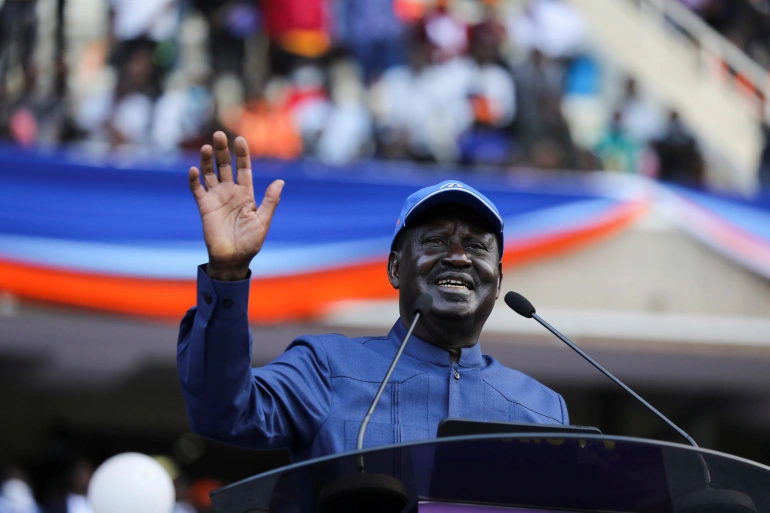
Former Kenyan Prime Minister Raila Odinga has died at the age of 80, family sources have confirmed to the BBC.
Odinga passed away on Wednesday while receiving medical treatment at a hospital in India.
Indian police told the AFP news agency that he was walking with family members and his personal doctor “when he suddenly collapsed.” He was rushed to a nearby hospital, where he was pronounced dead.
In recent weeks, speculation had mounted over his health, though family members and political allies had dismissed reports suggesting he was critically ill. Following news of his death, condolences have poured in from across Africa, including from Ethiopian Prime Minister Abiy Ahmed.
A towering figure in Kenyan politics, Odinga was a formidable political mobiliser who ran unsuccessfully for the presidency five times. He consistently rejected the results, claiming electoral fraud, and was vindicated by Kenya’s Supreme Court in 2017 when it annulled Uhuru Kenyatta’s victory and ordered fresh polls. Odinga later boycotted the rerun, demanding electoral reforms.
The disputed 2007 election — in which he again alleged vote rigging — plunged Kenya into its worst political crisis, leading to more than 1,200 deaths and the displacement of about 600,000 people.
A power-sharing deal brokered by former UN Secretary-General Kofi Annan ended the violence and paved the way for a unity government in which Odinga became prime minister.
Despite decades of political rivalry, Odinga often reconciled with sitting presidents after bitterly contested elections. After his most recent defeat in 2022, he joined President William Ruto in a “broad-based government,” which saw several of his allies appointed to key positions. He defended the move as necessary for national unity, following widespread protests that culminated in the storming of parliament, during which dozens were killed.
Earlier this year, the Ruto administration backed Odinga’s bid to become Chairperson of the African Union Commission, but he lost to Djibouti’s Mahmoud Ali Youssouf despite strong regional support.
Known affectionately as “Baba” (Father), “Agwambo” (Act of God), and “Tinga” (Tractor) — nicknames reflecting his powerful grassroots appeal — Odinga inspired a passionate following, particularly in western Kenya, his home region.
He was widely regarded as a master strategist and a tireless advocate for democracy and human rights. A former political prisoner, he was Kenya’s longest-serving detainee, spending nearly a decade in jail under the regime of Daniel arap Moi for opposing one-party rule.
Odinga’s first detention followed the failed 1982 coup attempt, which thrust him onto the national stage and began a political journey that would define Kenya’s democratic struggle for generations.
He will be remembered as one of Africa’s most resilient opposition leaders — a man whose fight for freedom, justice, and political reform shaped modern Kenya.
BBC