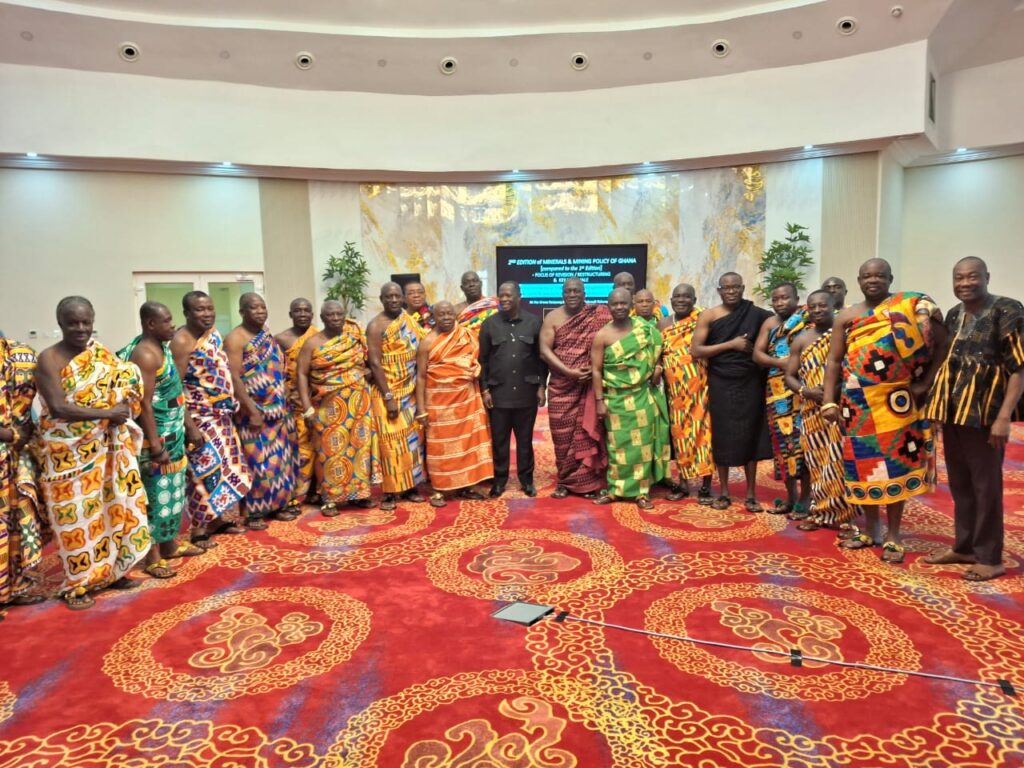
Emmanuel Armah-Kofi Buah, Minister for Lands and Natural Resources, has reaffirmed the government’s commitment to transforming Ghana’s mining sector through inclusive reforms and deeper collaboration with traditional authorities. On July 11, 2025, the Minister led a high-level delegation to engage with the Western and Western North Regional Houses of Chiefs at The Grove Essipong Beach Resort in Takoradi. The delegation included Mr. Martin Kwaku Ayisi, Chief Executive Officer of the Minerals Commission, and Mr. Benjamin Aryee, former CEO of the Commission and Chair of the Policy Review Committee.
The discussions focused on restructuring the community mining programme, enhancing environmental protection, and strengthening governance across the mining value chain. The goal is to update the legal and policy framework governing mining in Ghana and make it more responsive to national interests and community development.
The event was co-chaired by Ogyeahoho Yaw Gyebi II, President of the National House of Chiefs and Omanhene of Sefwi Anhwiaso, and Nana Kobina Nketsia V, President of the Western Regional House of Chiefs and Omanhen of the Essikado Traditional Area. Both leaders expressed strong support for the reform process and urged Parliament to rally behind the Ministry and the Minerals Commission to ensure the necessary legislative amendments are passed.
Buah expressed his gratitude to the traditional leaders for their continuous support, stating that it was an honour to return to his region of birth to engage with the custodians of the land. He emphasized the government’s plan to transition Community Mining into Cooperative Mining, introducing a structured model with local mini-refineries that empower communities and ensure environmental responsibility. He reiterated the importance of traditional authorities in the licensing process and noted that Community Development Agreements will be incorporated into the revised mining law to ensure direct social investment in host communities. He also stressed the need for a coordinated and firm approach in tackling illegal mining, including the enforcement of a “name and shame” principle to curb impunity.

Mr. Ayisi presented the government’s proposal to recategorize mining into small-scale, medium-scale, and large-scale tiers, a move aimed at creating pathways for Ghanaian miners to transition into larger-scale operations. He said the introduction of Cooperative Mining would promote local ownership and formalization. He further proposed the abolition of Development Agreements, which he noted have not served Ghana’s long-term interest. The Minerals Commission also intends to place a nine-year cap on prospecting licences to prevent land speculation and encourage timely development of mining projects.
Mr. Josef Iroko, Legal Manager at the Commission, explained the current legal responsibilities of traditional authorities as allodial landowners and discussed the function of the Office of the Administrator of Stool Lands in managing and disbursing rent payments to the chieftaincy institutions. He outlined the legal processes for compensation involving surface rights and land use.

Mr. Benjamin Aryee provided a comprehensive overview of the ongoing mining policy review, highlighting key global trends such as Environmental, Social, and Governance (ESG) requirements, climate change, and the use of innovative technology in the sector. He emphasized that the policy reforms seek to align Ghana’s mining framework with international best practices.
The chiefs welcomed the reforms but noted that any meaningful fight against illegal mining must begin with addressing its root causes, including inadequate land boundary demarcation and lack of public education. They pledged to support the government in its efforts to clean up the sector and strengthen environmental governance.
Among the key recommendations raised by the chiefs was the call for Small-Scale District Mining Committees to be chaired by traditional leaders rather than District Chief Executives for improved oversight and accountability. They also requested a clearer definition of Cooperative Mining to ensure local participation, and proposed that mining communities receive increased royalties and equity shares from mining operations. Furthermore, they advocated for the integration of social impact development clauses into mining lease agreements and called for a critical re-evaluation of the Community Mining Programme, which they argued has become a breeding ground for illegal activities.
In his concluding remarks, Hon. Buah assured the House of Chiefs that government remains committed to a collaborative approach that ensures all Ghanaians, especially host communities, benefit from the country’s mineral wealth. The session ended with a renewed sense of partnership between the Ministry, the Minerals Commission, and Ghana’s traditional leadership.
Also present at the meeting were Dr. Ahmed Tijani, Manager for Corporate Affairs and IT at the Minerals Commission, Mr. Francis Annobil Jnr, Takoradi Regional Manager, and staff from the Commission’s Tarkwa office.