NAIMOS, Blue Water Guards step up anti-illegal mining operations across regions

The Ministry of Lands and Natural Resources has reaffirmed government’s unwavering commitment to eradicating illegal mining (galamsey) through coordinated intelligence-led operations, stakeholder engagement, and active public communication.
Speaking at a media briefing on Friday, October 17, 2025, the Director of Communications at the Ministry, Mawusi Ama Mawunyefia, said the government’s approach to ending galamsey involves both enforcement and collaboration.
She emphasized that the ministry’s strategy is guided by transparency and shared responsibility with citizens, the media, and all stakeholders.
“We have a responsibility as a ministry to coordinate all efforts, take input from every well-meaning Ghanaian, and do this right,” Ms. Mawunyefia said. “Your responsibility as the media is to help us push out the right narratives, educate, and ensure that the public understands what government is doing.”
According to her, while the government remains resolute in its commitment, it is equally focused on ensuring that action matches rhetoric. “It is not just talk, but action. And we cannot do this in silence,” she noted.
Ms. Mawunyefia highlighted that the Ministry began a series of stakeholder engagements earlier in the month to strengthen policy and operational collaboration. One of these was the “Galamsey Speaker Series” hosted by the British High Commission, which brought together government officials, policy experts, and environmental stakeholders to identify corrective measures and refine the national anti-illegal mining strategy.
On the enforcement front, she disclosed that the National Anti-Illegal Mining Operations Secretariat (NAIMOS) and the Blue Water Guards — the two main task forces under the Ministry — have been active in recent weeks.
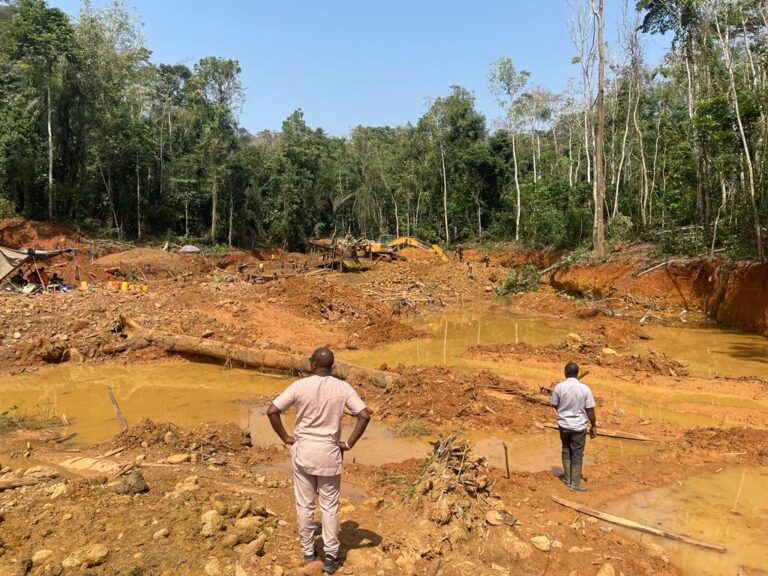
Last week, NAIMOS carried out operations in the Western Region, particularly in the Birim Central Municipality and the Asamankese enclave, where officers uncovered and dismantled several illegal mining sites and makeshift settlements.
This week, NAIMOS shifted its focus to the Eastern Region, covering Old Abirem, Kyenkyenku, and parts of the Oboho Forest Reserve. The operation led to the arrest of three individuals, the seizure of four excavators, five motorbikes, two heavy-duty water pumps, and several fuel drums. Dozens of makeshift camps and mining pits were also destroyed.
Meanwhile, the Blue Water Guards maintained surveillance in the Western Region, particularly around Wasa Agona and Tarkwa Nsuaem, where they intercepted illegal mining activities on water bodies and nearby farmlands.
Ms. Mawunyefia explained that while some seized equipment, such as water pumps, can be repurposed for agricultural use, others — including excavators and changfans — are demobilized or destroyed to prevent reuse.
“For materials that can be put to good use, we do so. Recently, we handed over some retrieved water pumps to the Ministry of Agriculture for distribution to farmers. But items meant for mass destruction, like excavators and changfans, are permanently disabled,” she said.
She further noted that the Ministry is reviewing existing mining policies and regulations to close gaps that make illegal mining profitable, stressing the need to make formal mining more attractive and rewarding.
“It must be easier to engage in mining legally than illegally. The current system creates the wrong incentives, and we are working to correct that,” she added.
Ms. Mawunyefia assured that the Ministry will continue to provide regular updates to the public on its interventions, progress, and challenges, stressing the government’s commitment to transparency in tackling the galamsey menace.