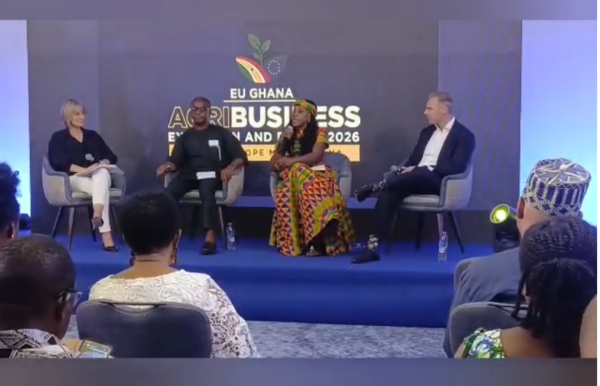
Alberta Nana Akyaa Akosa (2nd from right)
Founder and Executive Director of Agrihouse Foundation, Alberta Nana Akyaa Akosa, has described agribusiness entrepreneur Henri Wientjes as an example of a successful EU-Ghana business partnership that deserves to be studied by investors seeking to establish businesses in Ghana.
She said Wientjes’ approach to building agricultural businesses, which involved understanding local communities, identifying gaps in the sector and developing partnerships around their needs, offered important lessons for European businesses seeking long-term opportunities in Ghana.
Speaking at the EU-Ghana Agribusiness Exhibition Forum 2026 on Thursday (29 October), Ms Akosa highlighted his business experience while responding to questions on building successful partnerships between Ghanaian and European agribusinesses.
She described Wientjes as “an institution that needs to be studied”, citing his early engagement with communities and his role in developing agricultural business initiatives in Ghana.
According to her, Wientjes came to Ghana many years ago as a community trainer and travelled across different regions to understand the challenges facing the agricultural sector and identify areas where he could contribute.
She said his approach was different from that of businesses that enter new markets with ready-made solutions without first understanding the people and communities they intend to serve.
“He understood the people, the culture and their religion,” she said, emphasising that successful partnerships required investors to engage communities and understand their needs before introducing business solutions.
Ms Akosa cited the introduction of Yara, the Norwegian agricultural inputs company, into Ghana as one example of Wientjes’ approach to identifying business opportunities.
She explained that farmers at the time faced challenges accessing quality agricultural inputs, particularly in crop nutrition and crop solutions. Wientjes identified the gap and brought Yara into the Ghanaian market, eventually selling 70 per cent of his shares to the company.
She said this approach enabled Yara to enter an established business environment without having to repeat the initial groundwork of understanding the market and building relationships from scratch.
She also cited Wienco and Cocoa Abrabopa as part of Wientjes’ business initiatives in Ghana, adding that his experience demonstrated how local knowledge and community engagement could support the development of sustainable agribusiness ventures.
Ms Akosa further referred to his work in developing more than 1,000 locations involved in producing local seeds, describing his business journey as an example of a partnership model worth examining.
Drawing lessons from the experience, she said European investors and other businesses interested in Ghana’s agribusiness sector must conduct thorough research, visit communities, engage local associations and establish the credibility and capacity of prospective partners before entering into agreements.
She stressed that investors should not focus solely on immediate sales but should seek to build lasting relationships through continuous engagement and follow-through.
According to her, understanding local culture, identifying genuine needs and working closely with communities are essential to building successful and sustainable business partnerships.
The EU-Ghana Agribusiness Exhibition Forum 2026 brought together stakeholders to discuss opportunities for collaboration, investment, stronger agricultural value chains and improved market access for Ghanaian agribusinesses.