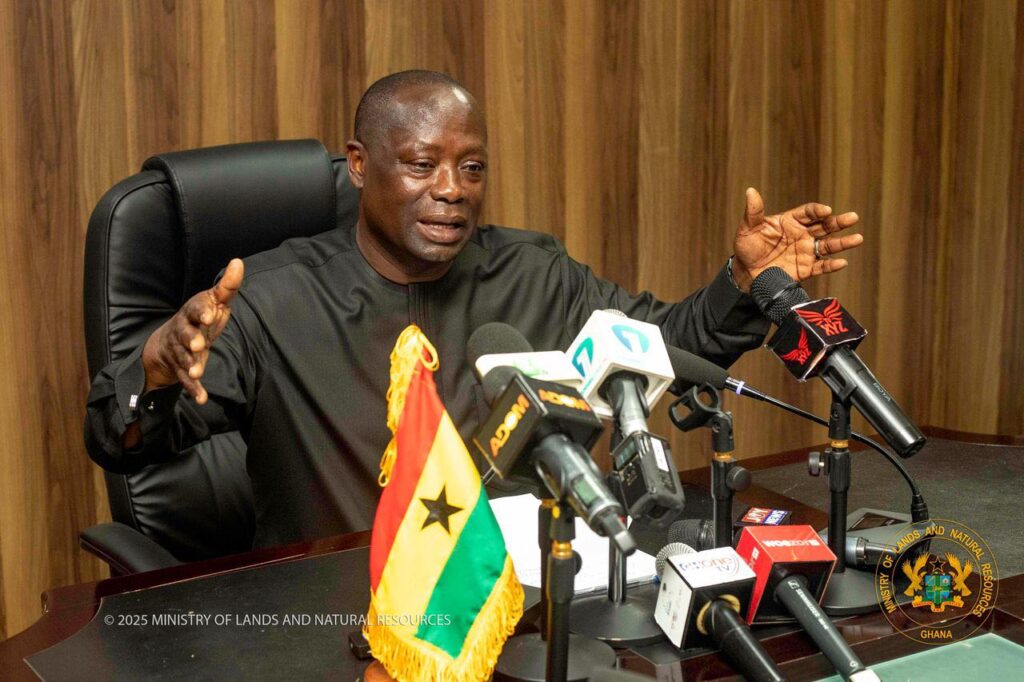
Emmauel Armah-Kofi Buah
Ghana’s Minister for Lands and Natural Resources, Emmanuel Armah-Kofi Buah, has announced that government is introducing a sliding-scale royalty regime for lithium and other minerals, following extensive national debate and recent volatility in global mineral prices.
Addressing the media on Wednesday, 3 December, the Minister said government has listened to concerns from traditional leaders, civil society organisations, communities in Mankessim, and the broader Ghanaian public, all demanding transparency, fairness, and adherence to law in the management of the lithium resource at Ewoyaa.
Buah emphasised that the legal foundation for mineral royalties remains central to government’s approach. He explained that although the Minerals Act initially set royalties between 3–6%, subsequent amendments fixed the rate at 5%, with a further amendment requiring a legislative instrument to guide future adjustments. However, that instrument was never developed.
“I’m happy to inform you that we have worked closely with the Attorney-General, and a comprehensive new instrument that will guide royalties for all minerals is ready to be sent to Cabinet and Parliament,” he said.
The Minister noted that a sharp decline in global lithium prices has stalled several projects worldwide, including the Ewoyaa Lithium project. This, he said, could lead to job losses and stall economic activity in the Central Region if Ghana fails to respond strategically.
He recalled that the Central Regional House of Chiefs and other stakeholders appealed to the President to prevent delays to the project due to current market challenges.
To protect national interest without driving investors away, Buah said the government is proposing a lawful sliding-scale royalty system.
This mechanism will according to him will maintain a lower royalty rate when lithium prices fall, ensuring the project remains viable and automatically increase the royalty rate when prices rise beyond an agreed threshold, ensuring Ghana earns more when market conditions improve.
He explained that this approach is superior to a fixed royalty because it adapts to price changes, unlike the existing static system.
“No one can convince me that when gold is at $2,000 and the royalty is 5%, the rate should remain the same even when gold rises to US$4,000. This is the right time to review all royalties in the mining sector,” he said.
Buah added that although some critics raised concerns about the initially announced 10% royalty at $3,000 lithium price, the new framework could deliver even higher rates when prices rise above that threshold.
The Minister assured the public that government will not shortchange the nation. He said the new royalty instrument will be finalized before Parliament considers the revised lithium agreement.
Listen to the audio clip below:
“We have listened to all voices and are taking steps to ensure not only that the project proceeds, but that Ghana gets full value for its resources,” he stated.
Watch the media briefing below: