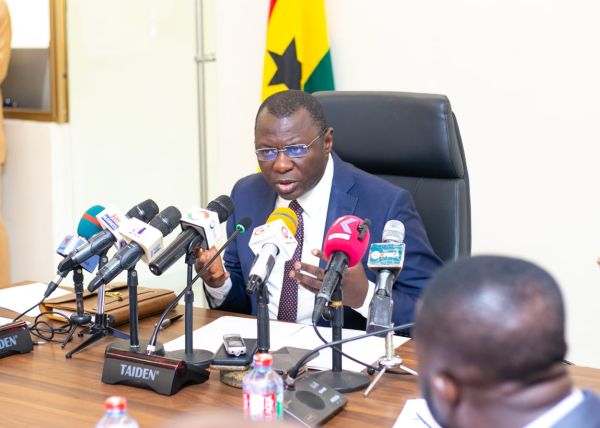
Mohammed Amin Adam
The Minority in Ghana’s Parliament has raised serious concerns about what it describes as a series of harmful government policies that threaten the very foundation of the country’s mining sector.
In a strongly worded letter dated April 21, 2025, the opposition cautioned that recent decisions by the government risk stifling growth, deterring foreign investment, and causing widespread job losses across the mining industry.
The letter, addressed to the Ministers of Finance and Lands and Natural Resources, warned that the government’s new direction could have “potentially dire” consequences for Ghana’s economy.
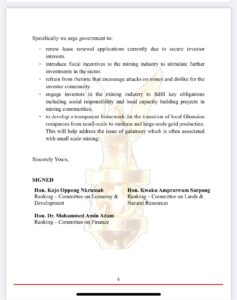
It was signed by three senior opposition lawmakers: Kojo Oppong Nkrumah, Ranking Member on the Economy and Development Committee; Kwaku Ampratwum Sarpong, Ranking Member on the Lands and Natural Resources Committee; and Dr. Mohammed Amin Adam, Ranking Member on the Finance Committee.
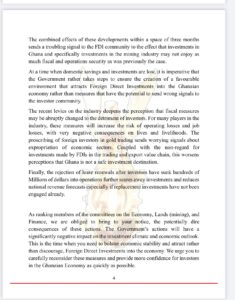
Central to their criticism were two new tax measures introduced by the government—a 3% Growth and Sustainability Levy on gross mining volumes rolled out in 2025, and another levy planned to be enforced from 2026 to 2028. According to the Minority, these levies operate like royalties and are pushing already struggling mines deeper into financial distress.
“These taxes are not only excessive but also ill-timed,” the letter argued. “They place an undue burden on mining operations, especially those that have not benefited from recent price booms.”
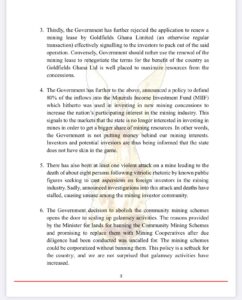
Equally troubling, the MPs said, is the recently enacted GoldBod Act, which prohibits foreign entities from trading and exporting gold. They warned that this law not only sends a negative signal to international investors but also violates the 1992 Constitution by retroactively affecting vested rights.
The opposition also took issue with the government’s refusal to renew the lease of the Damang mine, operated by Gold Fields Ghana. The decision, they claim, undermines investor confidence and discourages long-term investment in Ghana’s mining sector.
“Rather than forcing out experienced operators, the government could have used the lease renewal as an opportunity to renegotiate more favorable terms,” the MPs stated.
Their concerns didn’t end there. The Minority condemned the government’s decision to slash funding for the Minerals Income Investment Fund (MIIF) by 80%. The Fund plays a pivotal role in Ghana’s equity participation in mining, and the opposition sees the cut as a major setback in the country’s bid to secure a meaningful stake in its mineral wealth.
The letter also referenced a violent incident at a mining site, where eight individuals lost their lives. According to the Minority, the attack was likely inflamed by anti-investor rhetoric, and the slow pace of investigation has only intensified fears within the investor community.
Additionally, the Minority criticised the recent abolition of Community Mining Schemes. Rather than shutting them down, they argued, the government should have introduced stronger regulations to curb illegal mining activities.
In their concluding remarks, the opposition urged the government to reconsider its approach, reinstate lease renewals, reduce hostile rhetoric, and adopt a strategic plan to empower local mining firms.
“At a time when Ghana needs to strengthen economic stability, the government must act to attract—not repel—foreign direct investment,” the letter concluded.
Below is a copy of the statement