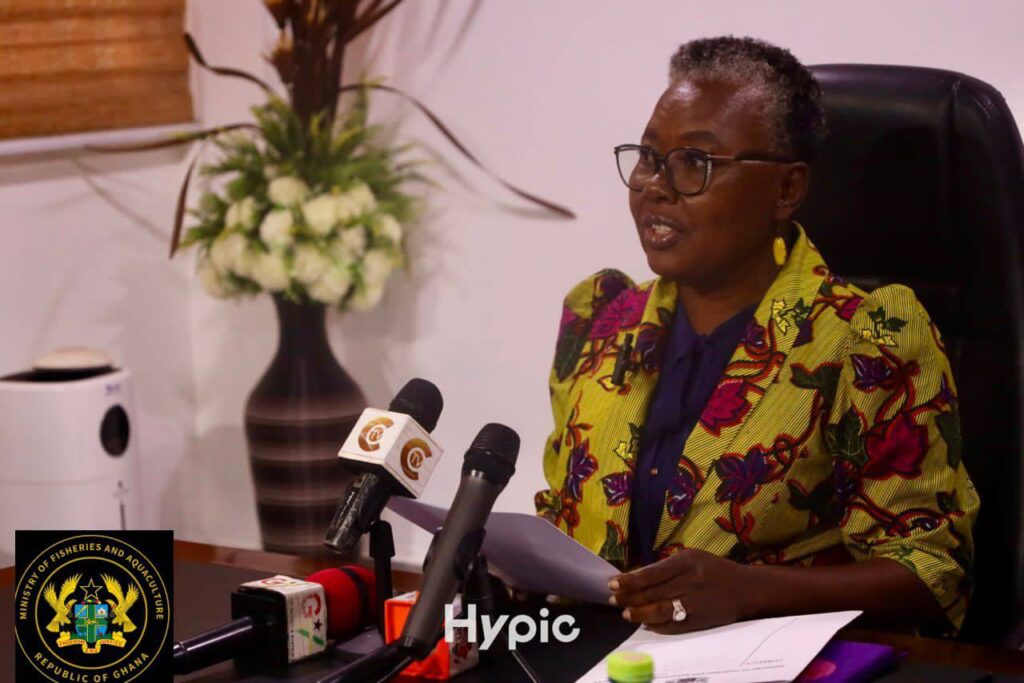
Ghana imports over 79,000 metric tons of fish annually to meet domestic demand, the Minister for Fisheries and Aquaculture Development, Emelia Arthur, has revealed.
She attributed this growing dependence on imports to marine pollution, illegal, unreported and unregulated (IUU) fishing, and the degradation of ocean habitats.
Madam Arthur made this known during a press briefing at the Ministry on Monday to announce the establishment of Ghana’s first Marine Protected Area (MPA) within the Greater Cape Three Points Area in the Western Region.
“Ghana’s marine fisheries have been under severe pressure from overfishing, habitat destruction, pollution, and IUU fishing,” the Minister stated. “As a result, domestic fish production has decreased, leading the country to import over 79,000 metric tons of fish annually to fulfil local demand. If current trends continue, these factors may further impact both marine ecosystem health and the livelihoods of coastal communities.”

According to her, the government is transitioning from non-spatial fisheries management methods to include spatial tools such as Marine Protected Areas.
Historically, Ghana’s fisheries management has relied on seasonal closures and gear restrictions, but there is now an increasing focus on spatial measures in response to current ecological challenges.
The adoption of MPAs, she explained, is intended to support fish stock recovery and ensure long-term ecosystem stability, in line with international best practices.
The Greater Cape Three Points Area, covering about 700 square kilometres and stretching from Ampatano to Domunli, has been scientifically identified as the most suitable location for the establishment of the MPA. The area serves as a critical breeding and nursery ground for sardinellas and other key fish species, an important migratory route for whales and dolphins, and a nesting site for marine turtles, making it an ecological hotspot that requires special protection.
Madam Arthur clarified that the introduction of the MPA will not impose a total ban on fishing but will instead promote responsible and sustainable fishing practices that safeguard the livelihoods of local communities. She added that the initiative also supports Ghana’s Blue Economy Strategy, which aims to balance the country’s blue wealth—encompassing fisheries, aquaculture, and tourism—with blue health, focusing on ecosystem restoration and biodiversity conservation.
On stakeholder engagement, the Minister disclosed that the Ministry, in collaboration with the Fisheries Commission and development partners, conducted consultations across 21 coastal communities, engaging over 7,000 stakeholders, predominantly fisherfolk and traditional authorities. A multi-stakeholder MPA Technical Advisory Committee guided the process to ensure broad consensus, community ownership, and compliance with international standards.
She further explained that the initiative aligns with several international frameworks, including the UN Convention on the Law of the Sea (UNCLOS), the Convention on Biological Diversity (CBD), the Abidjan Convention, Sustainable Development Goal 14, and the Kunming-Montreal Global Biodiversity Framework. It also complies with national legal provisions such as Articles 36(9), 41(k), and 269 of the 1992 Constitution, the Fisheries and Aquaculture Act (Act 1146), and Ghana’s Marine Fisheries Management Plan for 2022–2026.
Following Cabinet approval, the Ministry and the Fisheries Commission will map and gazette the Greater Cape Three Points MPA, conduct inter-ministerial consultations to build implementation support, make a public declaration of the MPA, and work with communities, NGOs and faith-based organisations to develop a participatory management plan.
The government will also embark on public education campaigns, strengthen monitoring and enforcement mechanisms, and promote alternative livelihoods for fishers who may be affected by the new conservation measures.
Reporting by Abigail Teye in Accra